I’m not sure whether Reno Walsh, one of the organizers for the Wine Bloggers Conferences, saw the video above yet where I talk about some of my experiences in a video by BKWine at the European Wine Bloggers Conference which I attended as a guest of Enoforum Wines, but he recently emailed me for feedback comparing the EWBC and the NAWBC. (You can also watch the video here: http://www.youtube.com/watch?v=lyp-TCJx7v)
As others might be interested in hearing some notes comparing and contrasting the various blogging and tech conferences I’ve attended in the past 18 months, I thought I’d expand a little, edit a little, and post those notes here–with an emphasis on the three Wine Bloggers Conferences I’ve attended of course.
Overall I suspect what’s MOST IMPORTANT to me and to many of my fellow tech oriented conference attendees is reliable wireless–being able to get on-line to tweet, blog, facebook, all that fun social media stuff when we want, are inspired or have the time.
The Wine Bloggers Conferences have failed on this three times now. Thankfully, at the EWBC, my host Enoforum Wines came through by providing Jo Diaz and I portable wireless devices which come with minutes. Jo used hers extensively; I had better luck getting on-line in my hotel rooms then she did–I admit I wasted way too much time on it, especially at the hotel where the EWBC was held. Too often I was trying to get on-line when I would have preferred attending the conference. I did end up paying for internet my last night in Lisbon: 12 hours for about $25 US.
At MacWorld in SF last January 2009 I found it was somewhat reliable around the Moscone conference center but my best bet was getting a press pass and getting online there–they knew enough to make sur ethat if anyone could get on-line it should be the press! I imagine they’ll ahve it dialed in for 2010–not sure yet if I’ll be there to see.
SF WordCamp 2008 and 2009 had PLENTY so we could all have as many windows open doing as much as we wanted all at the same time. Somehow they’ve been able to handle the needs of 700 tweeters blogging and bloggers tweeting; unfortunately, LA WordCamp did not quite have enough but the main problem was that we got kicked off if we didn’t upload anything after 10 minutes. I tracked down someone who could address that so the wireless worked much better in the afternoon.
IN DEPTH ED: At EWBC, I loved the day where we went on the cork forest tour with lunch and tastings followed by a visit to a cork plant. The day offered less drinking and tasting but lots of learning and camaraderie. This intensive, deep learning experience that really stuck with me, and others as well.
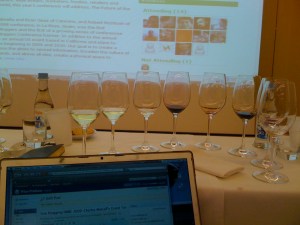
GRAND TASTING: As I mentioned in the video, I loved the grand hosted tasting Charles Metcalf did at EWBC. This should be a part of every WBC. Since the next WBC is in Walla Walla Washington, maybe they should have someone who really knows Washington and/or Oregon and/or Canadian wines. Or hey, why not Metcalf and Portuguese wines? Metcalf was fabulously entertaining…and I’d love to taste more Portuguese wines!
SESSIONS: At the EWBC 09, I admit I was very jetlagged Saturday morning and trying to get on-line in my hotel room, and so I missed the first morning sessions Saturday. I missed Friday’s sessions completely as I arrived Friday evening for dinner (about 11pm). I feel like I got more out of the conference sessions themselves at the NAWBC. I think they were more sophisticated, but then again I could have been too jetlagged to get much. I learned more from the sessions in 2008 but then I was still very new to blogging, social media, and wine back then (I’m still new but not nearly!)
SESSIONS 2 I missed Wine Academy of Spain Esteban Cabeza’s sherry, port and madeira tasting on Friday at EWBC as I was enroute but he kindly gave me a brief tutorial. These wines blew my mind. The NAWBC should definitely consider having him do his presentation at the NAWBC in WA as these wines are unknown and unappreciated by many in the US. I am still puzzling over madeira and sherry. Maybe if they were more appreciated here, good ones could be found more easily. (I just found an excellent Solera 1847 oloroso sherry from a local Henry Wine Group distributer. He admitted I couldn’t even buy it around here–I was able to buy it via a tasting at a local restaurant). It’d be great to have some American examples as well–I’d love to try Twisted Oak’s Pig Stai with a Port from Portugal.
KEYNOTES I loved the NAWBC keynotes in 2008 (Alice Feiring and Gary Vaynerchuk) and 2009 I enjoyed having a lunchtime keynote or morning like in 2009–Barry Schuler was unexpectedly brilliant.
BEST? I appreciated in 2009 just relaxing and enjoying the incredible dinner and wine and more intimate gathering and company at Pine Ridge after a long stimulating day instead of having a keynote! The meal at Pine Ridge was one of the best I’ve had in my life.
GIFT BAGS The gift bags at EWBC were slim compared to NAWBC but a lot of the stuff in the NAWBC bag was just “stuff” that I basically recycled.
BRINGING IT HOME 1: Since I live in California and can drive there and back, I’ve been able to bring lots of wine home, open bottles to taste with more leisure and samples. At EWBC I didn’t know how to get any of the wines and bring them back. I went to a grocery store and was overwhelmed and didn’t see much that I had tasted. While in Portugal, I tasted all these amazing wines that now I can’t find in my hometown in California!
BRINGING IT HOME 2 One of the best things a winery did in my three conferences: Michel-Schlumberger gave bloggers who went there on the wine hike a 50% discount; most people on the tour took them up on the offer. I’d encourage the wineries to go even deeper with discounts knowing that we’ll tweet, talk, taste, blog about the wines. So in the gift bags, maybe have a coupon code for deeply discounted wines. Not everyone is swimming in free samples (or wants to be).
BLENDING: This didn’t happen at EWBC or NAWBC but I’ve noticed a lot of interest in blending and blending activities on twitter. I know some WBC participants went to Twisted Oak to do some blending before the conference and that sounded like great fun. I think it would be a blast to do a blending activity/exercise/tasting as an official part of a WBC and EWBC too. I think I would learn a lot about wine/winemaking in the process and it would be fun. We could do it as teams–not self-selected teams but random so we’d meet new people–then we could try and rate the other team’s wine and figure out what was in it!! It would be even better if we could get a bottle of the blend to take home (for free or discounted). Maybe a few of the area wineries would be interested in hosting something like that.
I sent along some other ideas as well but I think 1200 words is enough on this subject!
 Tonight, Wednesday November 11, from 5:30-7:30pm Green Drinks Ventura County will be held at Wine Essentials, 2390 Las Posas, Camarillo. It’s a free networking gathering for folks in green lines of business and activism.
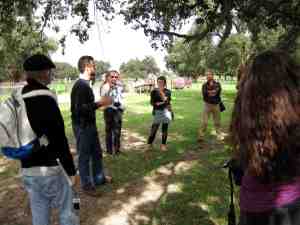 Randal Grahm, forgive me, I know you believe in the screwtop closure, but after visiting the cork oak forests in Ribatejo, Portugal today as part of the European Wine Bloggers Conference, I am now a firm believer in cork. And, if you’re listening, and I hope you will be, I will tell you why. I may not convince you in this post but hopefully by the next one.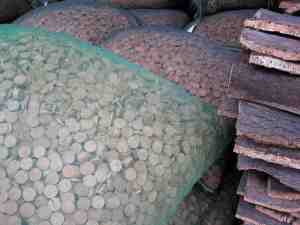
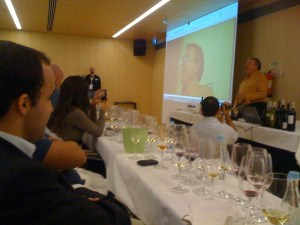 Next up at the European Wine Bloggers Conference: Charles Metcalf’s Grand tasting of Portugal. Metcalf wrote a book on wine and food in Portugal which makes him somewhat of an expert and certianly a worthwhile guide for a tasting of a variety of Portuguese wines. Certainly he has a lovely accent.