Pairing Albariño from Spain and Uruguay: Seek Seafood + Crab Cakes
Is Albariño the ultimate wine for summertime seafood? One of Spain’s most popular white wines, Albariño grows in Galicia on the north-western coast of Spain, and in northwest Portugal. If you’re looking for an aromatic, crisp wine to pair with oysters, crab, anchovies, scallops, swordfish, clams, even sole with beurre blanc…. look no further than Albariño, a light, bright white with sea fresh minerality that works well with seafood. While Albariño is most well-known from Spain’s Rias Baixas region where it has grown for 900 years, it’s grown in wine regions around the world including South America’s Uruguay which is producing Albariño along its coast. Albariño has a medium-sized, thick-skinned berry that’s susceptible to mildew. The wine can be made in several styles with bright acidity, floral aromas, and on the palate, peach, apricot, and citrus. grapefruit.
And what better day than today– Albariño Day, in the middle of summer, during a global heat wave– to pour this refreshing white wine into your glass?
Wait– Uruguay?
Finding Albariño from Spain to pair with your Spanish sardines or other seafood is easy. Most stores with a decent selection of wine will have a few Spanish Albariño to choose from, some on lees like the one we review below, even some with oak.
But Uruguay? Yes: Uruguay has a long wine making tradition, and over 300 wineries today. Albariño is the third most widely planted white grape in Uruguay — more Albariño vines planted than Chardonnay– and over 40 wineries making it into wine.
As I wrote here, “If you know anything about Uruguayan wines, you know about their tannat, because there is something special happening there with that grape: the terroir simply tames it and elevates it. But white wines? Yes! When Europeans settled along the coast of Uruguay, they planted the grapes they knew from home. From Galicia in Spain, they brought Albarino, from Germany they brought Riesling, and from France they brought Sauvignon Blanc and Viognier. Regardless of the grape, you’ll find, like we did, that the white wines of Uruguay reflect their proximity to the sea by expressing salinity, minerality, and a distinct character.”
Unfamiliar with Uruguay?
- Here’s our primer that focuses on tannat with pairings.
- Check out “Unexpected Uruguay”– wines that aren’t tannat! with pairings of course
- Here’s some more fun facts about Uruguay and its wines– and you guessed it, pairings!
- We loved this vermouth from Uruguay too.
- Here’s the Wines of Uruguay website.
Unfamiliar with Spain’s Rias Baixas?

Rias Baixas, Spain
According to local legends, the Rías Baixas in Galicia are traces left by God’s fingers where he rested his hand. With the Atlantic Ocean to the west and north, Galicia has over 1000 miles of coastline. As the Atlantic reaches inland, it forms estuaries. The Rías Baixas mix fresh water with salt water to sustain a rich and diverse population of aquatic life–and provide an excellent place to grow Albariño to pair with the abundant seafood! Here’s lots of ideas for pairing Rías Baixas Albariño.
In “From California’s Camino Real to Galicia’s Camino de Santiago: All Aboard for Albariño 2!” find more pairing ideas plus I wrote these nine fun facts:
- The largest region and most productive region is Val do Salnés, known as the birthplace of Albariño.
- The warmest area produces just over 20%, and that’s Condado do Tea.
- O Rosal is on the right bank of Miño River, and grows 11% of production
- Ribeira do Ulla has 3.3%
- Soutomaior grows 2%
- Often a pergola trellising system raises the grapes head high above the ground and uses granitic blocks — one vine per block– so vines are widely spaced and can handle the high humidity that’s common in the region for most of the year.
- Vines are largely cared for and pruned by women
- Over 50% of the winemakers in the region are women.
- The impacts of climate change has brought riper stone fruit flavors, less acidity and citrus.

Pairing Albariño from Spain and Uruguay
Albariño Wine from Spain and Uruguay
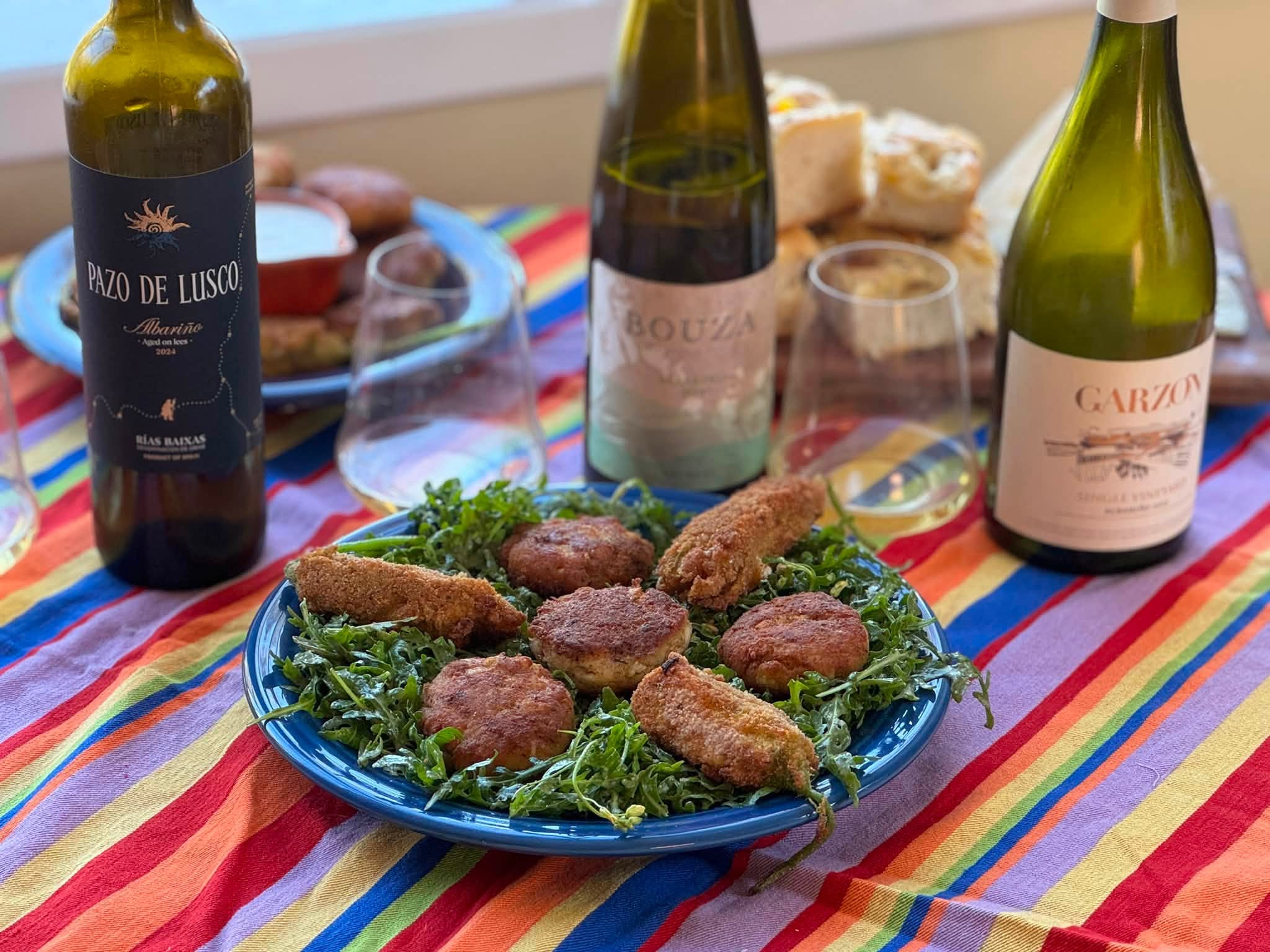
- Pazo de Lusco 2024 Albariño, Spain
- Bouza 2024 Albariño, Uruguay
- Bodega Garzón 2023 Garzón Single Vineyard Albariño, Uruguay
Menu for Albariño
- 12 mo aged Manchego from Spain
- Sue’s Favorite Focaccia with homegrown cherry tomatoes and rosemary
- Goat cheese stuffed breaded squash blossoms
- Crab cakes with aioli on a bed of arugula salad with a lemony dressing

Pazo de Lusco 2024 Albariño, Rías Baixas, Galicia, Spain
Pazo de Lusco 2024 Albariño, Rías Baixas, Galicia, Spain
ABV: 13.0%
SRP: $25
Grapes: Albariño
Importer: Gonzalez Byass
sample for my review
Read more about Paso de Lusco 2024 and their Albariño.
Appearance: Pale lemon yellow, creamy, pale pale yellow rim
Aroma: Lemon, grapefruit, banana, grassy, fresh pineapple
Palate: Lemon curd, tart eureka lemon, bright acidity, roundness on the palate, fresh pineapple, salinity, oxalis, preserved lemon.
Pairing: The wine goes well with the nutty contrast of the Manchego cheese, lovely with the bread responding nicely to the herbs and the vine ripened tomatoes. Great with the squash blossom, the salad and the crab cake and the aioli. My favorite with this wine was with the zingy salad. Every element of the meal goes together even the aioli on the squash blossom, and with the wine all of the wonderful flavors come together.

Bouza 2024 Albariño, Uruguay: the label has wine all over it because a bottle of tannat broke in the shipment
Bouza 2024 Albariño, Uruguay
ABV: 12.5%
SRP: $28
Grapes: Albarino
Importer: Elixir
sample for my review
The Bouza family originally came from Galicia, so naturally, they planted Albariño, and were the first to plant albariño in Uruguay. Their tasting notes mention preserved lemon, which we certainly found (and we don’t read tasting notes from others in advance of our own tasting). They suggest pairing it with a filet of sole with beurre blanc. Yum! Next time!
Appearance: Pale lemon, a little gold, platinum rim
Aroma: Minerality, a pit of petrol, a hint of stone fruit, preserved lemon
Palate: Tart lemon, a hint of petrol, lime, salinity, slick, very pleasant, fresh nectarine.
Pairing: Great oyster wine, so good with the bread as it loves the herbs and bright tomato and the yeastiness. Nice with the Manchego as well. The minerality of the wine and the garlic flavors in the food go so well together; the food becomes sweeter, even richer, and the food brings out a unique sweetness in the wine.

Bodega Garzón 2023 Garzón Single Vineyard Albariño
Bodega Garzón 2023 Garzón Single Vineyard Albariño
ABV: 14%
SRP: $35
Grapes: Albariño
Importer: Winebow
sample for my review
With the granitic soils at Garzón and the rainy Atlantic climate of Uruguay, Alberto Antonini saw planting albariño as a natural choice. They now have over 100 acres planted to the grape, and they produce three in each vintage including the Single Vineyard.
In a ZOOM, I learned their Albariño is served around the world including Bad Bunny’s restaurant in Puerto Rico, and it was described as “white flesh peaches make love with magnolia in an oyster shell bed.” The ocean can be seen from the vineyards.
A favorite pairing is chanterelle risotto because while it pairs well with seafood, it has acidity and body to pair well with lots of other dishes. They suggest that their interpretation of the grape “delivers the richness many wine drinkers look for in chardonnay, without relying on oak, a wine that’s meaty enough to provide a refreshing balance to roast pork loin or a veal chop.” We agree!
Appearance: Lemon yellow, kind of golden, pale yellow rim, clear
Aroma: Lemon curd, preserved lemon, herbs, bay, rose geranium
Palate: Tart lemon, key lime curd, mineral, salinity, zippy throughout the palate, well balanced, zesty
Pairing: Manchego and this wine are perfect together. The herbs in the bread are very nice together with the wine, but the crab cake and aioli with this wine are an over the top pairing. This wine is so great with everything about this meal. We also tasted this wine with steamed clams that had serrano jamon, garlic, butter, and wine, and it was so great that we have to do this again sometime.

