Wine Blogging Wednesday #69: Did you hear me howling “mourvedre”?

This month’s Wine Blogging Wednesday, hosted by The Passionate Foodie, asks us to sniff out some “dog strangler” wine aka mourvedre.  So, for the 69th edition Wine Blogging Wednesday that’s what I did.

Actually I began my search for wines with mourvedre nearly two years ago when I first tasted a 2001 rbj theologicum which blends 50% of the mourvedre sinner with 50% of the saintly grenache.

I thought I’d died and gone to heaven and hell all at once.

Instead, I was on a search to find a wine I could barely pronounce, and which I could barely find. Fortuantely for me, the grateful Palate Warehouse used to be located only a few miles away and they would periodically  open their doors and let us in.

And that’s how I discovered a straight mourvedre–a rbj 2002 Mataro which I opened on a camping trip in the heart of the Sierras.

So when I discovered this month’s Wine Blogging Wednesday featured possibly my favorite varietal, and certainly one that makes my favorite blends shine, I howled with delight.

And then howled some more–what wine to choose? Or more precisely, whose?

An obvious choice would be Twisted Oak. Their mourvedre with the macabre red skull emblazened across the bottle is stunningly good. And they do my favorite blend mourvedre, grenache and syrah aka “Potty Mouth” that I love–especially the 2003 which is still available in their library.

Another obvious choice is Randall Grahm’s Bonny Doon. It seems he recovered rhone varietals like grenache and mourvedre from obscurity in California. And his Cigar Volant is always noteworthy.

So after much agonizing and howling at the crescent moon, I went for a winery I discovered in December and which maybe I can help you discover too (although they have thousands of facebook fans so obviously some people know them already!)

The wine with more than 50% mourvedre that I chose for this edition of Wine Blogging Wednesday comes from Core Winery, run by Dave and Becky Corey, with financial backing and support from many family members.

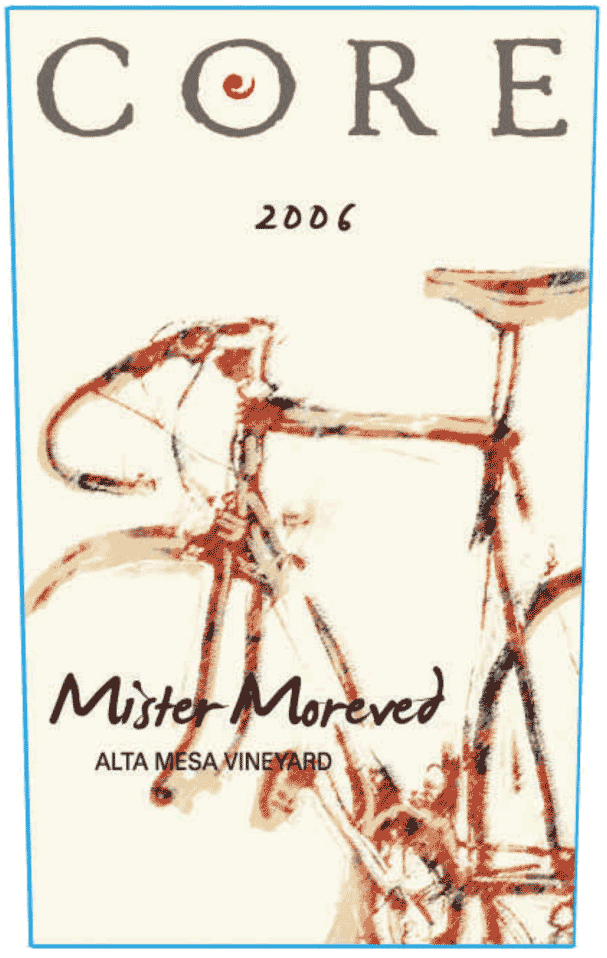
And it’s Hard Core. Seriously Hard Core. A 2005 Hard Core made up of 60% mourvedre, 25% grenache, and 15% cabernet sauvignon.

Only 665 cases of this wine was produced, and it’s all gone except for what might be in people’s cellars–and a handful of splits which I found at the winery when we went by the other day.

We went to the Core winery as part of a wedding anniversary extravaganza (ok we went to Sycamore Hot Springs, Go Westy, Los Olivos for lunch and tasting at Carhartts and Carina) that started with dinner on our anniversary where I brought in a bottle of the 2006 Hard Core. While I prefer my syrah with mourvedre and grenache, my husband definitely prefers his syrah with a backbone of cab to it. Continue reading

WBC-or-Bust: Wine Predator Throws Hat Into Ring for Trip to WA Wine Country!

I’m signed up.

Signed up to what?

Compete in the WBC-or-BUST contest.

The what?

The WBC-or-Bust Contest!

Yeah, right!

No –Write! Write about Washington wines! Live it up! Be driven around to various top-notch wineries from Seattle to Walla Walla! Be wined AND dined! Stay in a way cool B&B along the way!

See the badge there on the sidebar? That means I’m official!

Well, can I go?

Only if you sign up and follow these “Rules & Guidelines”!

TO ENTER If you don’t already have one, create a free WineCHATr.com blogger account. Choose a “WBC-or-BUST” badge/banner from your WineCHATr.com account manager. Add the badge source code to your blog website, so that it is visible from any page.

Warning: This is a pain in the neck. But if I can do it, you can do it. They have a few badges to choose from. I like this one the best.

TO QUALIFY Once the WBC-or-BUST badge has been properly added to your blog website, simply blog about Washington wine throughout the span of the contest. No less than one Washington wine post must be published to remain eligible.

I don’t think this one will count, do you?

TO WIN 12 winning bloggers will be named at the conclusion of the campaign. Four (4) winners will be selected at random out of all qualifying participants. Two (2) winners will be chosen for posting the most Washington wine related blog entries (minimum of 150 words required for each post). Six (6) additional winners will be chosen for the best category based posting:

  • Top 2 Best Washington winery posts
  • Top 2 Best Washington wine or tasting note posts
  • Best Washington growing region post
  • Best Washington vineyard post

The huh? The final four winners will be selected at random out of all qualifying participants? Random? Can you see me scratching my head? Maybe 2 random and 2 because the writing overall was good or the person showed lots of potential or had proven her worth by blogging like a mad dog at other conferences?

Oh and FYI This post has 700 words if we count the title, well over the required number of 150 words per post. Since I tend to write posts of 750-1000 words, do you think I should break them into parts in order to be more competitive? Or add lots of extra words to my sentences?

A few more words in the fine print:

* Your blog has to have been started before the end of October 2009 (no problem there–I started this blog August 2008 and started psoting regularly October 2008; my main blog, Art Predator, I started November 2007).
* Washington bloggers/residents can’t compete (I’m definitely a Californian!)
* You have to have a ticket to WBC 10 (and those are selling out fast! I’m applying for a scholarship, but if that doesn’t come through, Reno is saving me a spot.)
* You have to make a 1 minute video and post it to you-tube and leave a link in your blog Just kidding! But here’s mine anyway! Just insert Washington Wine whenever I say M-G. I’m an equal opportunity blogger (within reason!)

Below are more details about this amazing opportunity. Check it out and you’ll see why I want to be on that bus or bust!

ROAD TO WALLA WALLA: June 23rd – 25th

DAY 1: Seattle & Woodinville Wine Country
WBC-or-BUST Preview - Day 1 Experience some of the best Washington has to offer from one of the premier food & wine destinations in the Northwest. {view itinerary}

DAY 2: Yakima Valley & Walla Walla
WBC-or-BUST Preview - Day 1 Travel across the Cascade Mountain Range to visit Washington’s premier growing regions and taste through a selection of premium wines. {view itinerary}

DAY 3: Start of the Wine Bloggers Conference
Arrive to Walla Walla in style just in time for the WBC with a deeper understanding of Washington and its thriving wine industry.

So here goes! Until this contest ends at the end of April, there will definitely be a Washington Wine slant to this blog. It’s gonna be a blast! And maybe I’ll get to blast off in June to my next wine adventure–in Washington!

Now to find my notes from the WA wines I tasted at WBC…they’re here somewhere!

Portugal: bike paths lined with poetry & wine so good it rarely leaves the country

“The river of my village doesn’t make you think about anything.
When you’re at its bank you’re only at its bank.”

“The Tejo has big boats
And there navigates in it still,
For those who see what’s not there in everything,
The memory of fleets.”

Lines from “O Guardador de Rebanhos” by Portuguese writer Fernando Pessoa (written under his pseudonym, Alberto Caeiro) Image of the Tejo And Lisbon Aquarium by Gwendolyn Alley.

Last fall, I wrote an essay for a contest to travel to Portugal to taste wine in the Alentejo Region and to write about it. I came in as runner-up but when winner Sonadora of the blog Wannabe Wino canceled a few days before, trip sponsor Enoforum Wines invited me to go in her stead and accompany their publicist Jo Diaz of Wine Blog fame; Sonadora went in January 2010 and posted extensively while there.

(In addition to traveling and tasting in the Alentejo Region,  I was also able to attend the European Wine Bloggers Conference. Read more about the contest and my entry: October 26, 2009 I’m a WINNER! Wine Predator to Attend European Wine Bloggers Conference & Enoforum Oct 30-Nov. 5!.)

Traveling in Portugal–exploring the scenic castles, discovering the delicious, flavorful cuisine, tasting the nicely balanced wines–was delightful and I jotted down as many of those experiences as possible and posted them as quickly as possible on my blog: I just didn’t sleep since my days were filled from dawn to well after dark! (I kept telling Jo, “we can sleep when we’re dead!”) Read about our whirlwind travels here.

I thought it would be easy to write about Portugal when I came home. I had lots of ideas for blog posts. But writing more deeply about Portugal and my experiences there proved problematic.

Writing about how and why Portugal impacted me and changed me is hard because my brief time in Portugal had a profound impact on me–and that surprised me. There are a number of reasons but one is that I had no idea that the Portuguese had such a reverence for two of the most important aspects of life to me: the land and literature. A bonus is they love to walk and ride bikes!

To write about Portugal is to try to express the importance of taking care of the land and expressing a love of life through the written word, through literature. Literature lives in the hearts of the Portuguese people–lit is not just a class they have to get through, literature and writers truly are revered by the Portuguese. Poets, playwrights, writers of all stripes are respected in a way I had never seen before–certainly not how we’re treated here in the US!

Likewise, living “green” and practicing sustainability is the way of life in Portugal. People who live and thrive in one place for so many generations learn this in order to survive there and not run out of natural resources. According to my host Delfim Costa of Enoforum Wines, unlike other European countries, Portugal’s priority was not colonizing. Instead they established a series of ports so they could keep exploring–and then return home again (and drink wine!)

Writing about Portugal in a way that honors it and really shows people why it is special is more difficult than I thought.

After our adventures in Alentejo, where we stayed in a castle with this view of the Roman Aquaduct, saw how closely people live to the land,  and enjoyed numerous meals of Portuguese cuisine paired with fabulous, affordable wines (most are under $20 US, around $10 in Portugal), Delfim drove us to Lisboa. We had a little time on our hands to explore and since our hotel was located on the waterfront near the Aquarium  that’s where we walked.

Inside the spacious aquarium, the best one I’ve ever seen or could imagine, instead of only interpretive text, the Portuguese chose to post on the walls marine-oriented poetry in English and in Portuguese.

Outside the Aquarium, we enjoyed walking along by the shore, the site of the 1990 Europian Exposition. Stalls which housed exhibits about various countries now were home to different restaurants featuring ethnic cuisines. The evening weather was mild and we saw plenty of people strolling and riding bicycles.

Our last very full day in Portugal was spent in Lisboa and the Palace at Sintra; our last dinner was in a restaurant featuring fado singers (Delfim interpreted the lyrics)  and incredible food. I would have enjoyed several days in each and I lapped up every moment: we even convinced the guard at Sintra to let us in after closing. I would have raced up the stone steps to the top if I wasn’t so concerned that Delfim and Jo would be worried.

We walked along the shores of the Tejo which greets the Atlantic near Lisboa and we saw under construction broad bike and pedestrian paths displaying roadways. As a cyclist, I was thrilled to see that Lisboa was making this move; I also knew that Lisboa recently hosted an Aeolian Ride (more Lisbon Aeolian ride photos here by Jessica Findley; I also plan to do a post about the Aeolian Ride there and in Santa Barbara in October). What better way to know a place than by traveling the countryside tasting wine and eating traditional meals or by getting out of a car to walk or cycle?

While I never did get a chance to go for a bike ride, the importance tot he Portuguese of language, of poetry, and of staying connected to the land resonated within me.

On our last morning, we went  to the Jeronimos Monastery and saw the tomb of the famed Portuguese poet Luis de Camoes (1525-1580) who led quite an adventurous life, traveled to India and China by ship, and more which enriches his epic poem The Lusiads about Vasco de Gama on the voyage that ultimately connected Europe to India. He is such an important figure to the Portuguese that his birthday is Portugal Day and quotes from his work are commonly and prominently placed on decorative edifices in Portugal. Read one of Luis Camoes poems here.

Because Enoforum Wines recognizes that a wine is more than the grapes, that it includes the poetry of the people who make the wine and live on the land, Delfim bought me a copy of the epic poem The Lusiads as well as a collection by Fernando Pessoa.

The following words by Pessoa grace the now open pedestrian and bicycle path. Watch a video of Portugal’s Poetic Paths here:

“The river of my village doesn’t make you think about anything.
When you’re at its bank you’re only at its bank.”

“Through the Tejo you go to the World.
Beyond the Tejo is America
And the fortune you encounter there.
Nobody ever thinks about what’s beyond
The river of my village.”

“The Tejo runs down from Spain
And the Tejo goes into the sea in Portugal.
Everybody knows that.
But not many people know the river of my village
And where it comes from
And where it’s going.
And so, because it belongs to less people,
The river of my village is freer and greater.”

“The Tejo has big boats
And there navigates in it still,
For those who see what’s not there in everything,
The memory of fleets.”

“The Tejo is more beautiful than the river that flows through my village,
But the Tejo isn’t more beautiful than the river that flows through my village,
Because the Tejo isn’t the river that flows through my village.”

Read more about Portugal’s poetry lined paths http://www.treehugger.com/files/2010/02/portugals-new-bike-paths-are-filled-with-poetry-video.php.

Portugal offers so much more than port! Beautiful landscapes, an extensive literary tradition, stunning castles, amazing food, bicycle paths lined with poetry, and more! Yes, more Portugal posts coming up!

EWBC Day 2: A visit to a cork forest–but first, a word about TCA

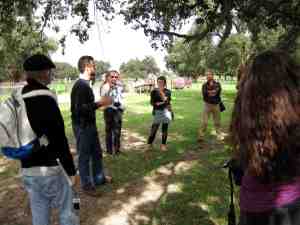
winebloggers learn about corkSMRandal Grahm, forgive me, I know you believe in the screwtop closure, but after visiting the cork oak forests in Ribatejo, Portugal today as part of the European Wine Bloggers Conference, I am now a firm believer in cork. And, if you’re listening, and I hope you will be, I will tell you why. I may not convince you in this post but hopefully by the next one.
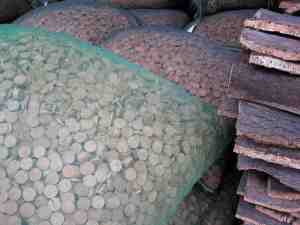
Cork as a closure for wine got a bad name because some wines became “corked” which means that they became infected with TCA and turned bad.

While this is a rare occurrence, if it is YOUR special wine that got corked, you’re not going to be a happy camper about it. You will be tempted to turn against cork. (Read another post about cork taint here.)

Alternative closures to cork are nothing new. Really. But they have become more popular in recent years. So popular that it has had an impact on the cork industry and that industry is fighting back. With both fists. And a LOT of money–millions in fact into research and development to understand where TCA comes from and how it can be prevented.cork rings at Amurim cork factory in Ribatejo Portugal

Turns out, TCA infection can come from a variety of sources, not just cork. The cardboard box, for example. Just about anywhere, actually. But cork was and is the prime suspect so the cork industry has figured out ways to sanitize the corks and remove the risk of TCA almost completely so that instances of TCA from cork sources are reduced to the point where the many benefits of using natural cork (instead of a screw top or a plastic cork) shine and win.

Yes, cork is more expensive, much more expensive than a screw top or a plastic cork which costs practically nothing and adds practically nothing to the value of the wine.

But there is more to the picture than a simple closure. And in my next post, I will tell you about the cork trees, cork forests, and the natural ecosystems and the human communities that revolve around healthy, productive cork industry–an industry which relies on YOU, the consumer and the wine producer, staying with cork.

And one day soon, I hope to show you pictures of my new beautiful cork floors!!

Wine Predator Arrives at the European Wine Bloggers Conference in Lisbon!

After 24 hours of travel, last night I arrived in Lisbon where Enoforum Wine’s Delfim Costa picked me up and escorted me to the VIP Hotel nearby –just in time to join in the evening’s festivities of dinner and tasting.

Most of the dishes on the buffet was new for me and I loved everything I tasted. Two kinds of octopus! Beans cooked in bacon or some variation of goodness using the flavor and fat from a pig (mmmn, bacon!)

But the real standouts of the evening were wines from Douro. The first I tasted was one that Delfim wrangled from one of the Douro Boys. It was spectacular and I swear I will find out what it was. Between us, Delfim suspected that it might be the best wine in the room. For me, it offered everything I want in a wine, especially a wine to enjoy with a meal. Keeping in mind that when I tasted it last night I was running on adrenline and no sleep having spent the previous 36 hours traveling! But my palate knows an amazing wine when one crosses it. This wine was complex–rich, full, fruit, yet also delicate notes of rose. I think I could taste a whole bottle of it and still be discovering nuances.

With my desserts, Delfim and I went in search of another red wine and some port. Well, the room was full of partially empty and completely empty bottles, but we found another red from Douro and a port (name to be inserted here soon!). Then we spied a 10 year tawny (name to be inserted here soon!), and the search was over. Delfim poured samples for me and himself as well as  his colleague Luis and Jo Diaz who organized the wine blogging contest from which I won my trip. It was a lovely tawny and I’d been hankering for some tawny for awhile so it was great to have that itch scratched. As the hour grew later, Delfim then Luis excused themselves, leaving Jo and I to talk and enjoy the tawny.

Earlier I’d watched with interest as one of the Douro Boys carried in a case. What treasures might be there? But as Jo and I were engaged in conversation, and happy with  the tawny, we continued as we were instead of joining the boisterous group at the other end of the room.

Fortunately for us, one of the Douro Boys (name to be inserted here!), brought over a white port, a very special old bottle of white port.

I am ruined. I’d never had a white port before (insert picture here!).  Now I’ve had one of the best, followed by a 1983 aged port which the Douro Boy served to us from a decanter to capture the sediments. Doubly ruined. The 1983 was fantastic–almost like Disney’s Fantasia, like a wind that purrs at times and other times pounces. It was like little cat feet dancing on my tongue. And for flavor–how to describe? Funny thing is the first descriptors are anise or licorice. I don’t like that flavor. Yet I loved it here. Jo found it too cold at first and smooth like silk satin. We both warmed ours up a little, and found more texture and more to the nose, which she described as velvet, as red and rich as a monk’s robes.

I brought the remnants of each into my room with me. When I tasted the 1983 again, it was all about SPICE SPICE SPICE! Like I had stuck my nose and my tongue into a spice cabinet! Eventually I narrowed it down to mostly cinnamon with some clove.

Come back to see the pictures, to click some links, and to see the names when I get a chance. In the meantime, here’s my first installment from the European Wine Bloggers Conference at the VIP Hotel in downtown Lisbon, Portugal!!

Wine Blogger’s Conference 2009

So in July I attended the 2009 Wine Bloger’s Conference and I live blogged about it on one of my other blogs, Art Predator. I figure it’s about time to get those posts over here, so in the next few days, I’ll post them. Enjoy!

Wine Blogging Weds #61: At the source & drinking the juice–a visit to Old Creek Ranch Winery

WBWlogo Thanks to Wine Blogging Wednesday founder and this month’s host Lenn Thompson of the blog Lenndevours: The New York Cork Report who prompts us this month to visit a winery–to taste and blog about a wine after visiting the source with bonus points for actually tasting with the winemaker.  Here’s the complete story on his blog.

Where should I go? Well, it wasn’t much of a question as I had limited time available. While I am fortunate to have Sideways wine country practiOld Creek Road Winery open 909cally in my backyard, I simply contacted Michael Meagher, winemaker at Old Creek Ranch Winery, which is about 15 minutes away from my home near the beach and Michael invited me over last Friday for when his first load of grapes arrive–viognier!Winemaker MM at OCRW with 2009 Viognier

To hint at what kind of experience I had: I came home happily covered in grape juice, tasted the delish grenache blanc about to be bottled with the winemaker, and brought home the recently bottled but not yet released and not even labeled yet 2008 viognier!!

A little background: Old Creek Ranch Winery, established in 1981, is up Highway 33 on the Old Creek Ranch between the towns of Ojai and Ventura, California on a historic winery site. On the left is a picture of what remains of that winery; in the foreground is the native food plant, narrow-leaf milkweed, for monarch butterfly larva. historic winery now monarch butterfly preserve

According to the Old Creek Ranch  website:

The Ranch is part of a Spanish 22,000 acre land grant awarded to Don Fernando Tico, dating back to the early history of California. In the late 1800’s Antonio Riva of northern Italy purchased the ranch. He was a chef in Paris, London and later in San Francisco. He built a winery on the ranch at that time.

Wines were made without electricity and utilized gravity as a means to move the wine in the processing. Riva produced wine until about 1942, including the prohibition years. Wine purchasers would leave an order and money on the clothesline and would return later to pickup a jug of red wine left at the base of an oak tree.Old Creek Road ends at the winery

My first experience with Old Creek Ranch Winery Continue reading