Wine Predator Releases Poetry Collection “Middle of the Night”

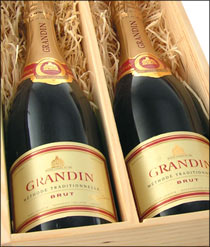
Tonight we celebrated the release of my new poetry collection, Middle of the Night Poems from Daughter to Mother :: Mother to Son from en theos press–and we chose champagne, of course!

Actually, Grandin, to be precise, is a French sparkler NOT from Champagne but from the Loire Valley.  I picked up at a tasting at a local restaurant featuring wines from the Henry Group and others. I paid around $20 for it and found it a refreshing change from the typical supermarket sparklers which most of us more commonly enjoy. It offers fine bubbles and lots of complexity–not sweet or fruity, but nutty (almond and hazelnut) with lots of acid (lime? lemon?), spice, and yeast.

We had the Grandin with a dinner of fresh shrimp right off the boat, simply prepared in butter and garlic, with pasta, and I have to admit that it was gone before I realized I lacked sufficient wine notes to say much about it except that, given the opportunity, I would absolutely buy it again.

Read more about Middle of the Night Poems from Daughter to Mother :: Mother to Son from en theos press, the poetry collection we were celebrating, below. By the way, this is NOT a collection of poetry about wine…but poetry by someone who LOVES wine!

New Poetry Book Arrives! Just in time for the Women’s Conference in Long Beach on Monday, I have 108 signed limited edition copies of my new poetry book, Middle of the Night Poems From Daughter to Mother :: Mother to Son (en theos press). I also put my “chop” on it: a special jade stamp the traditional red wax with my name in Chinese. The signed limited edition published for the Women’s Conference will be available at the Devone Designs Perfect Fit Jewelry display in the … Read More

via The Write Alley

WBW# 68: I Got Gamay, Babe!

Today is Wednesday, Wine Blogging Wednesday, so last night I prepared for my task of “Got Gamay?” by opening up a bottle which is readily available to most consumers. Wondering what I am talking about? (Cue up Sonny and Cher singing a variation of “I Got You, Babe” as “I Got Gamay, Babe!”)

“Drink What You Like” hosts April’s Wine Blogging Wednesday 68 – Got Gamay? where wine bloggers from around the world taste and blog on a common theme each month (thanks to  Lenn Thompson of New York Cork Report who started the monthly event over five years ago!) The host writes, “Gamay is unfortunately best know as the grape that produces Beaujolais Nouveau, popularized by George Duboeuf.”

Since we also had a pork tenderloin planned for dinner, possibly stuffed with canned plums (yum!), I thought I’d double check around the web and see what people had to say about this pairing where I found this article on various chefs’ wine pairings with pork tenderloin.While each chef had a different wine to suggest depending on the presentation of the pork, I found one chef who appreciates beaujolais with the “other” white meat: Continue reading

Portugal: bike paths lined with poetry & wine so good it rarely leaves the country

“The river of my village doesn’t make you think about anything.
When you’re at its bank you’re only at its bank.”

“The Tejo has big boats
And there navigates in it still,
For those who see what’s not there in everything,
The memory of fleets.”

Lines from “O Guardador de Rebanhos” by Portuguese writer Fernando Pessoa (written under his pseudonym, Alberto Caeiro) Image of the Tejo And Lisbon Aquarium by Gwendolyn Alley.

Last fall, I wrote an essay for a contest to travel to Portugal to taste wine in the Alentejo Region and to write about it. I came in as runner-up but when winner Sonadora of the blog Wannabe Wino canceled a few days before, trip sponsor Enoforum Wines invited me to go in her stead and accompany their publicist Jo Diaz of Wine Blog fame; Sonadora went in January 2010 and posted extensively while there.

(In addition to traveling and tasting in the Alentejo Region,  I was also able to attend the European Wine Bloggers Conference. Read more about the contest and my entry: October 26, 2009 I’m a WINNER! Wine Predator to Attend European Wine Bloggers Conference & Enoforum Oct 30-Nov. 5!.)

Traveling in Portugal–exploring the scenic castles, discovering the delicious, flavorful cuisine, tasting the nicely balanced wines–was delightful and I jotted down as many of those experiences as possible and posted them as quickly as possible on my blog: I just didn’t sleep since my days were filled from dawn to well after dark! (I kept telling Jo, “we can sleep when we’re dead!”) Read about our whirlwind travels here.

I thought it would be easy to write about Portugal when I came home. I had lots of ideas for blog posts. But writing more deeply about Portugal and my experiences there proved problematic.

Writing about how and why Portugal impacted me and changed me is hard because my brief time in Portugal had a profound impact on me–and that surprised me. There are a number of reasons but one is that I had no idea that the Portuguese had such a reverence for two of the most important aspects of life to me: the land and literature. A bonus is they love to walk and ride bikes!

To write about Portugal is to try to express the importance of taking care of the land and expressing a love of life through the written word, through literature. Literature lives in the hearts of the Portuguese people–lit is not just a class they have to get through, literature and writers truly are revered by the Portuguese. Poets, playwrights, writers of all stripes are respected in a way I had never seen before–certainly not how we’re treated here in the US!

Likewise, living “green” and practicing sustainability is the way of life in Portugal. People who live and thrive in one place for so many generations learn this in order to survive there and not run out of natural resources. According to my host Delfim Costa of Enoforum Wines, unlike other European countries, Portugal’s priority was not colonizing. Instead they established a series of ports so they could keep exploring–and then return home again (and drink wine!)

Writing about Portugal in a way that honors it and really shows people why it is special is more difficult than I thought.

After our adventures in Alentejo, where we stayed in a castle with this view of the Roman Aquaduct, saw how closely people live to the land,  and enjoyed numerous meals of Portuguese cuisine paired with fabulous, affordable wines (most are under $20 US, around $10 in Portugal), Delfim drove us to Lisboa. We had a little time on our hands to explore and since our hotel was located on the waterfront near the Aquarium  that’s where we walked.

Inside the spacious aquarium, the best one I’ve ever seen or could imagine, instead of only interpretive text, the Portuguese chose to post on the walls marine-oriented poetry in English and in Portuguese.

Outside the Aquarium, we enjoyed walking along by the shore, the site of the 1990 Europian Exposition. Stalls which housed exhibits about various countries now were home to different restaurants featuring ethnic cuisines. The evening weather was mild and we saw plenty of people strolling and riding bicycles.

Our last very full day in Portugal was spent in Lisboa and the Palace at Sintra; our last dinner was in a restaurant featuring fado singers (Delfim interpreted the lyrics)  and incredible food. I would have enjoyed several days in each and I lapped up every moment: we even convinced the guard at Sintra to let us in after closing. I would have raced up the stone steps to the top if I wasn’t so concerned that Delfim and Jo would be worried.

We walked along the shores of the Tejo which greets the Atlantic near Lisboa and we saw under construction broad bike and pedestrian paths displaying roadways. As a cyclist, I was thrilled to see that Lisboa was making this move; I also knew that Lisboa recently hosted an Aeolian Ride (more Lisbon Aeolian ride photos here by Jessica Findley; I also plan to do a post about the Aeolian Ride there and in Santa Barbara in October). What better way to know a place than by traveling the countryside tasting wine and eating traditional meals or by getting out of a car to walk or cycle?

While I never did get a chance to go for a bike ride, the importance tot he Portuguese of language, of poetry, and of staying connected to the land resonated within me.

On our last morning, we went  to the Jeronimos Monastery and saw the tomb of the famed Portuguese poet Luis de Camoes (1525-1580) who led quite an adventurous life, traveled to India and China by ship, and more which enriches his epic poem The Lusiads about Vasco de Gama on the voyage that ultimately connected Europe to India. He is such an important figure to the Portuguese that his birthday is Portugal Day and quotes from his work are commonly and prominently placed on decorative edifices in Portugal. Read one of Luis Camoes poems here.

Because Enoforum Wines recognizes that a wine is more than the grapes, that it includes the poetry of the people who make the wine and live on the land, Delfim bought me a copy of the epic poem The Lusiads as well as a collection by Fernando Pessoa.

The following words by Pessoa grace the now open pedestrian and bicycle path. Watch a video of Portugal’s Poetic Paths here:

“The river of my village doesn’t make you think about anything.
When you’re at its bank you’re only at its bank.”

“Through the Tejo you go to the World.
Beyond the Tejo is America
And the fortune you encounter there.
Nobody ever thinks about what’s beyond
The river of my village.”

“The Tejo runs down from Spain
And the Tejo goes into the sea in Portugal.
Everybody knows that.
But not many people know the river of my village
And where it comes from
And where it’s going.
And so, because it belongs to less people,
The river of my village is freer and greater.”

“The Tejo has big boats
And there navigates in it still,
For those who see what’s not there in everything,
The memory of fleets.”

“The Tejo is more beautiful than the river that flows through my village,
But the Tejo isn’t more beautiful than the river that flows through my village,
Because the Tejo isn’t the river that flows through my village.”

Read more about Portugal’s poetry lined paths http://www.treehugger.com/files/2010/02/portugals-new-bike-paths-are-filled-with-poetry-video.php.

Portugal offers so much more than port! Beautiful landscapes, an extensive literary tradition, stunning castles, amazing food, bicycle paths lined with poetry, and more! Yes, more Portugal posts coming up!

Wine Blogging Weds #65: Wines for Winter! Let it snow! No more rain!

What would you drink with a side of snow? That was this month’s Wine Blogging Wednesday prompt from Wine Girl who suggests that no matter where we live, we “imagine Snow. Snowmen, snow balls, igloos, snow trucks, snow … cold, cold snow. Then I want you to imagine what [wine] that makes you want to drink.” She continues, “With a valid story behind you, there’s no reason you can’t pop open a cognac, a brandy, or even bourbon.”

So as my hometown in southern California is getting battered by a week of wet and wild storms, and after a few days of filling some 30 sand bags and shoveling way too much mud during breaks in the rain, I am hiding out inside to face the monthly Wine Blogging Wednesday question: what to taste and what to drink? And this time complicated by the option of fortified wines and more!

My first thought was my go to evening wintry drink, port, maybe tasting one each from three continents–Portugal (naturally!), Australia (probably Jonesy), and a Kachina port that was in the gift bag at the Wine Bloggers Conference last summer (here’s a review of the Kachina port to indicate why I’m looking for a tasting occasion!)

But then I thought about the lovely madeira and the sherries I tasted with Esteban Calabezas in Portugal at the European Wine Bloggers Conference and realized I would have the perfect excuse to open the Gonzalez Byass Solera 1847 Oloroso Dulce I picked up from a tasting by the distributor, Henry Wine Group. I think I paid around $20 for it; online you can find it from $16-$30.

Then I was given a birthday present, a very special birthday present, and I knew that offered a choice, this beverage would be NUMBER ONE on any snow day. I was ACHING to pour it over fresh powder!

A stone mason, Janine Hegy, is staying with us in order to attend the Stone Foundation Symposium going on in town. On the night of my birthday, she presented me with a small glass of a very dark liquid over ice. The delicate gold laced glass she served it in had been one of my grandmother’s and it’s twice as old as I am. The cold temperature made it difficult to get much in the nose, but once in my mouth, I almost swooned. Amazing–it had the exact essence of a perfectly ripe blackberry picked from deep in the cool shadows of the bush on a hot summer day. With just the right amount of sweetness but not cloying, I could taste the pollen from the flowers, the earth it grew in. Bliss in a glass.

Janine had picked the organic berries from her property where they grow beside her barn and she made the drink herself using her grandmother’s recipe which she gave me to share here: In a one gallon jar place 5 quarts fresh, ripe, clean blackberries with 4 cups sugar and one bottle Korbel Brandy. Janine insists that it MUST be Korbel and only Korbel for the magic to take place. Store for two months in a cool dark place, stirring occasionally. Strain and bottle. Drink plain or over ice for a bit of heaven. A second, slightly less intense batch can be made using the same fruit by adding more Korbel Brandy.

She handed me a very small, very precious bottle holding maybe two jiggers. And I suppose I could taste it again and write about it for Wine Blogging Wednesday #65. But that’s not a fair choice for Wine Blogging Wednesday, eh? Something that rare, that special? Something that you can’t get your hands on unless you sneak into my house in the dead of night?

So I surveyed my options and went for the Sherry: Gonzalez Byass Solera 1847 Oloroso Dulce.

Now what I actually know about sherry would fit on the head of a cork (and yes this bottle is stoppered by a real cork). Esteban Cabeza gave me an abbreviated yet accelerated lesson in sherries, ports and madeiras at the European Wine Bloggers Conference which I was attending along with Jo Diaz thanks to our hosts Enoforum Wines.  I’d been in Portugal just over 24 hours and had had an amazing day and when I got my lesson,  it was getting late into the night. I’d lived a week in the previous 48 hours. I’m ashamed to say that I don’t remember as much as I wish about it all but I can tell you that it invigorated my curiousity about all things fortified! And as I learn, I will share it all here, of course!

Fortunately, the web has a wealth of information about just about everything, including, of course, sherries. According to Wikipedia, “Sherry is produced in a variety of styles, ranging from dry, light versions such as finos to darker and heavier versions known as olorosos, all made from the Palomino grape. Sweet dessert wines are also made, from Pedro Ximenez or Moscatel grapes.” With Esteban, I’d had

  • Manzanilla s straw colored (yellow) variety of fino Sherry, auestere but with a finish that lasted for months I swear
  • Amontillado a little darker, sweeter, less sharp than Manzanilla, easier to savor at first; it is aged under flor then exposed to oxygen

First off, this is not the same kind of sherry that I had it Portugal–this one’s an Oloroso which means ‘scented’ in Spanish and it’s aged oxidatively for a longer time than a fino or amontillado, making it a darker and richer wine and with an alcohol levels between 18-20%, more alcoholic.[10] And it’s made with 75% Palomino and 25% Pedro X.

In the glass, it’s cherry cola colored–like flat cherry cola, brown and kind of blah looking. As I drink some down, it gets more tawny colored and pretty–orange pink sunset colors shifting as I swirl the glass and the dark amber liquid catches the light.  Legs line the glass. When I stick my nose down in it, the color reminds me of a golden tiger eye.

What I’m saying here is what started out as a bland looking beverage on closer inspection has all the variances and depth of a winter sunset.

Hmmn, if I’m not careful I’m going to be picked up by the wine blogging police led by Jeff over at Good Grape for being too over the top! So what does it smell and taste like? I’m wondering that myself. Unlike the other two sherries I tasted with Esteban, this one is clearly sweet. But it doesn’t coat the tongue, it’s not syrupy, there’s some acid that cuts through.

Obviously I am in over my head but I’ll keep flailing away. And pour myself some more.

Ahh, that’s part of it–this one is tooo easy to drink. The other sherries I had in Portugal I just wanted to savor and marvel. This one, as far as sherries go in my very very limited experience, is somewhat simple. Sweet and simple. Here’s an analogy: if your basic sherry is like the  cheapest hollow  chocolate Easter bunny, maybe with some fake almond flavoring,  this would be like one of those Hershey kisses with an almond inside. No, actually more like a walnut.

Backing up now–what does it smell like? One website, The Wine Doctor,  describes it as having “axle grease” on the nose. Maybe I’m using the wrong glasses. What shape of glass am I supposed to be using to taste sherry, I wonder. I’m sure my new Reidel glases from Jo Diaz would do the trick–even if they are for syrah!

But there is something there I’m getting on the nose beyond the baked goods, carmelized sugar, raisins and nuts…Maybe if I had some axle grease handy to compare it with?

And finally, the finish. Sad to say, there isn’t much of one. What I’m longing for is the lingering long finish of those sherries I tasted. (Somewhere in the universe I swear I have notes on what those mythical sherries were!)

Is the  Gonzalez Byass Solera 1847 Oloroso Dulce sherry from Spain worth $20? Yes. I’m glad I bought it and I will enjoy drinking it. Is it what I’m hankering for? This is the third type of three sherries. Maybe I’m just not as big a fan of this style, or maybe this type of sherry at this price point.  But given the limited offerings in my home town, I’m grateful that I have this sherry around during this epic rainstorm here in southern California to keep me warm and cozy. And yes, and little baked too. I think I’ll have another splash of it before bedtime.

EWBC Day 2: A visit to a cork forest–but first, a word about TCA

winebloggers learn about corkSMRandal Grahm, forgive me, I know you believe in the screwtop closure, but after visiting the cork oak forests in Ribatejo, Portugal today as part of the European Wine Bloggers Conference, I am now a firm believer in cork. And, if you’re listening, and I hope you will be, I will tell you why. I may not convince you in this post but hopefully by the next one.
Cork as a closure for wine got a bad name because some wines became “corked” which means that they became infected with TCA and turned bad.

While this is a rare occurrence, if it is YOUR special wine that got corked, you’re not going to be a happy camper about it. You will be tempted to turn against cork. (Read another post about cork taint here.)

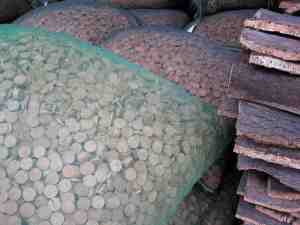
Alternative closures to cork are nothing new. Really. But they have become more popular in recent years. So popular that it has had an impact on the cork industry and that industry is fighting back. With both fists. And a LOT of money–millions in fact into research and development to understand where TCA comes from and how it can be prevented.cork rings at Amurim cork factory in Ribatejo Portugal

Turns out, TCA infection can come from a variety of sources, not just cork. The cardboard box, for example. Just about anywhere, actually. But cork was and is the prime suspect so the cork industry has figured out ways to sanitize the corks and remove the risk of TCA almost completely so that instances of TCA from cork sources are reduced to the point where the many benefits of using natural cork (instead of a screw top or a plastic cork) shine and win.

Yes, cork is more expensive, much more expensive than a screw top or a plastic cork which costs practically nothing and adds practically nothing to the value of the wine.

But there is more to the picture than a simple closure. And in my next post, I will tell you about the cork trees, cork forests, and the natural ecosystems and the human communities that revolve around healthy, productive cork industry–an industry which relies on YOU, the consumer and the wine producer, staying with cork.

And one day soon, I hope to show you pictures of my new beautiful cork floors!!

Wine Predator Arrives at the European Wine Bloggers Conference in Lisbon!

After 24 hours of travel, last night I arrived in Lisbon where Enoforum Wine’s Delfim Costa picked me up and escorted me to the VIP Hotel nearby –just in time to join in the evening’s festivities of dinner and tasting.

Most of the dishes on the buffet was new for me and I loved everything I tasted. Two kinds of octopus! Beans cooked in bacon or some variation of goodness using the flavor and fat from a pig (mmmn, bacon!)

But the real standouts of the evening were wines from Douro. The first I tasted was one that Delfim wrangled from one of the Douro Boys. It was spectacular and I swear I will find out what it was. Between us, Delfim suspected that it might be the best wine in the room. For me, it offered everything I want in a wine, especially a wine to enjoy with a meal. Keeping in mind that when I tasted it last night I was running on adrenline and no sleep having spent the previous 36 hours traveling! But my palate knows an amazing wine when one crosses it. This wine was complex–rich, full, fruit, yet also delicate notes of rose. I think I could taste a whole bottle of it and still be discovering nuances.

With my desserts, Delfim and I went in search of another red wine and some port. Well, the room was full of partially empty and completely empty bottles, but we found another red from Douro and a port (name to be inserted here soon!). Then we spied a 10 year tawny (name to be inserted here soon!), and the search was over. Delfim poured samples for me and himself as well as  his colleague Luis and Jo Diaz who organized the wine blogging contest from which I won my trip. It was a lovely tawny and I’d been hankering for some tawny for awhile so it was great to have that itch scratched. As the hour grew later, Delfim then Luis excused themselves, leaving Jo and I to talk and enjoy the tawny.

Earlier I’d watched with interest as one of the Douro Boys carried in a case. What treasures might be there? But as Jo and I were engaged in conversation, and happy with  the tawny, we continued as we were instead of joining the boisterous group at the other end of the room.

Fortunately for us, one of the Douro Boys (name to be inserted here!), brought over a white port, a very special old bottle of white port.

I am ruined. I’d never had a white port before (insert picture here!).  Now I’ve had one of the best, followed by a 1983 aged port which the Douro Boy served to us from a decanter to capture the sediments. Doubly ruined. The 1983 was fantastic–almost like Disney’s Fantasia, like a wind that purrs at times and other times pounces. It was like little cat feet dancing on my tongue. And for flavor–how to describe? Funny thing is the first descriptors are anise or licorice. I don’t like that flavor. Yet I loved it here. Jo found it too cold at first and smooth like silk satin. We both warmed ours up a little, and found more texture and more to the nose, which she described as velvet, as red and rich as a monk’s robes.

I brought the remnants of each into my room with me. When I tasted the 1983 again, it was all about SPICE SPICE SPICE! Like I had stuck my nose and my tongue into a spice cabinet! Eventually I narrowed it down to mostly cinnamon with some clove.

Come back to see the pictures, to click some links, and to see the names when I get a chance. In the meantime, here’s my first installment from the European Wine Bloggers Conference at the VIP Hotel in downtown Lisbon, Portugal!!

Portugal: where they have wine & corks & PORT!

As I pour myself my usual evening port (Jonesy from AUS $9 at the Ventura WIne Company), I have to laugh to myself because it just now occurred to me that I would be in Portugal, land of PORT! Seriously, I’ve been thinking about the trip we’ll make to a cork forest, and traveling the Alentejo wine region with Enoforum Wines as my host and live blogging at the European Wine Bloggers Conference…and and being in EUROPE where I’ve never been and so much to think about with travel and passports and packing and and and

I realize that I will be in the land of Port. Wow. I think I’ll have a little more please.