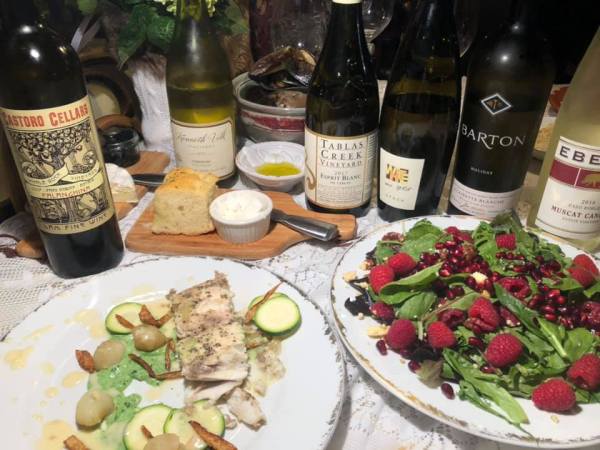
Castoro 2017 Falanghina CCOF estate
ITALY: white grape; sample
Kenneth Volk 2012 Verdelho
PORTUGAL: white grape; purchased
Barton 2017 “HOLIDAY” Clairette Blanche
FRANCE: Rhone white grape; sample
Epoch 2018
FRANCE: Rhone white grape blend: grenache blanc leads–
biodynamic; Sue purchased at winery
Tablas Creek 2017
FRANCE: Rhone white grape blend; Rousanne leads; sample
Eberle 2018 Muscat canelli
GREEK/ITALY: Greek white grape but most well known as Italian
Answer: These wines are all from Paso Robles CA and all might be considered wines made from “god-forsaken grapes” — grapes that are not common or unexpected in their home country AND not likely to be found outside their home country where they might not be all that appreciated either. And that’s the theme for this month’s Wine Pairing weekend prompt hosted by Culinary Cam– “godforsaken grapes” — a title that I hate that goes with a book I haven’t read but that I understand is quite entertaining and well written.
As people think first of red wines when think about wine from Central California’s Paso Robles if at all, we thought it would be fun to feature these uncommon and unexpected yet delightful white grapes from this less well known and under-appreciated region that is best known for its zinfandel, syrah, and cabernet blends — wines that are rich and red and often high in alcohol because so much of the AVA gets really hot in the summer.
Tablas Creek, Halter Ranch, Turley, and Justin are some of the better known labels with the first two of them focused on Rhone, Turley with zinfandel, and Justin with Cabernet and other Bordeaux red grapes.

2020 is barely a week old, but as I’m calendaring the year’s prompts for #ItalianFWT, #WinePW, #Winophiles, winemaker lunches and trade tastings in LA as well as other activities like the Wine Media Conference in Oregon and wine travel to Europe and South America, I’m reflecting on what we accomplished here on Wine Predator in 2019– and trying to decide what to submit for the Born Digital Awards (see what articles I submitted to the Millesima contest here).
I’m not really sure how we found the time, but Sue and I participated in EVERY SINGLE monthly prompt for Italian Food Wine Travel aka #ItalianFWT, Wine Pairing Weekend aka #WinePW, and the French Winophiles #Winophiles.
Time’s always moving on. Nothing can stop it. The question is whether we use our time well or not. We can't do anything about the past, but what happens in the future depends on what we do now. We can create a happier future by remembering that in being human we are all the same.
We joined wine bloggers and influencers from around the world but mostly from the US as we tasted and wrote about wines together following prompts that the group developed and organized sometimes with samples, and sometimes not.
Here on Wine Predator, that means 36 posts altogether at 15-20k words each! That’s the word count of a good sized book!
For almost every single article, I researched the region, the wine, the winery, and Sue and I both researched the cuisine to come up with menus and pairing ideas. Continue reading →
From Franciacorta in the north in Lombardy and Friuli in the northeast to Toscana in central west and Sicily in the southwest, Italy is full of wines to discover. With over 2000 indigenous grapes grown in the 20 regions, the range of wines and expressions makes getting to know and understand Italian wine an interesting challenge as I discovered last year during the VinItaly Wine Ambassador Course.
Think it’s time to tune up your Italian wine game in 2020?
During this time of reflection, I have a few wines worth remembering — and recommending along with a few blog posts you might want to revisit.
Here on Wine Predator in 2019 we researched, tasted, and wrote about hundreds of wines in 123 posts with 176,090 words averaging 1432 per post.
That’s like writing three novels.
So when it comes time to sort through all of these posts to choose some favorites to submit to year end contests like this one and for year end wrap-ups here on Wine Predator, I asked for some help from some of my loyal readers and friends.
I also asked Sue– but I wanted something different from her — not the best, but ten posts that were the most memorable. Not necessarily her favorite wines or meals but the ones that made the best, the strongest memories for her.
“When first asked to do this task,” says Sue, “I did not realize just how many posts we put out this year. How do you take 116 and pick out 10 of your favorite children. Some are so rich with our experiences. So many experiences, so many memories, such an abundance of fantastic wine and food. I was then told to focus on exceptional wines. Did that make it any easier? I find that my favorites evoked such great times rich with foods that paired beautifully with the wines we served them with.
The most memorable wines come with the most memorable experiences.
“The wine and the food shine together making it a memorable event,” she continues. “I was able to narrow it down to 30 right away. Bringing it down to the 10 most memorable took some time, but here it is:
5. Chile’s Odfjell Biodynamic Reds and Pastel de Choclo – Every time I research menus and pair the wine of the region with the cusine of the region it is always a hit. These wines were outstanding and with the menu it was over the top
For the category of Wine Pairing, there are SO MANY TO CHOOSE FROM — like probably 100! I considered a few including Rasteau which is a solid post but ended up debating these two which Sue also really liked: