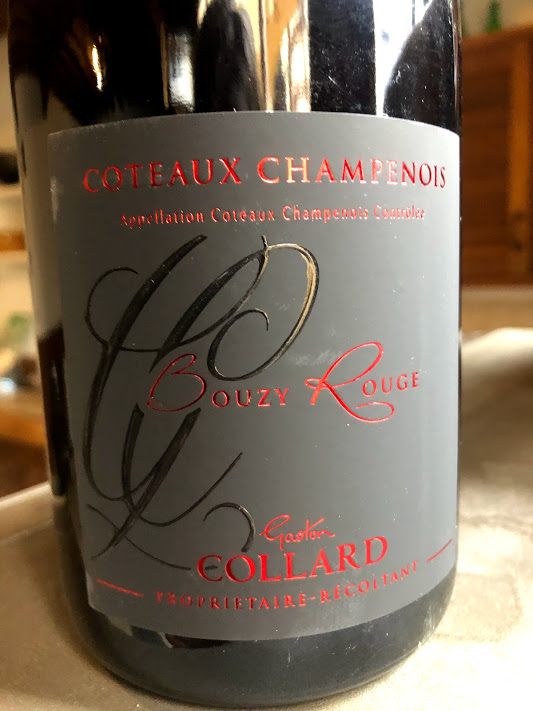
Bouzy Rouge from Gaston Collard. It’s a thing– an unexpected pleasure, a red wine in Champagne!
Red still wine? In Champagne?
During my visits to Champagne just before harvest in 2018 and at the end of harvest in 2019, I tasted many unexpected pleasures including Gaston Collard’s biodynamic red wine made from Bouzy pinot noir in the barrel and the bottle.
Yes, red wine from Bouzy is a thing– a Champagne thing — and it’s called Coteaux Champenois. What an unexpected pleasure!
Because when we think about wine from Champagne, usually it’s the big sparkling wine houses that come to mind– the labels we see on a regular basis in the grocery store like Moet & Chandon, G. H. Mumm, Laurent Perrier, Bollinger, Veuve Cliquot, Taittinger, Piper-Heidsieck, Nicolas Feuillatte.
Just like when we pop open a bottle of Coca-Cola we expect a specific flavor, we expect these big brands, and their flagship labels, to have a certain, consistent, standard profile which they achieve from their proprietary dosage which is added before bottling.
All roads lead to Champagne! Also– these cookies– biscuits of Reims–another unexpected pleasure.
But Champagne is full of unexpected pleasures!
These include biodynamic wines like Vincent Charlot (read more here) and Leclerc Briant (discussed below) and organic wines too that express the terroir and the vintage, wines full of distinct personalities, wines with little or no added sugar, even red and white still wines like they are allowed to do in Bouzy!
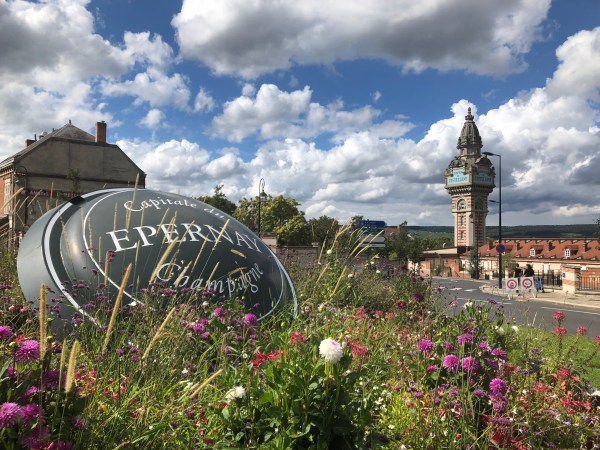
So let’s virtually visit today in advance of the June #Winophiles exploration of unexpected pleasures in Champagne along with some picnic pairings!
Above are photos from our visit to Gaston Collard in Bouzy. We tasted through the wines and visited the cellar where we tasted the Bouzy rouge from the barrel.
You know about red wine: you know that it’s red because “red” or dark skinned grapes get pressed and the juice and the skins hang out together for a little or a long time.
You know about white wine: you know it’s white because “white” or light skinned grape get pressed with little contact with the skins and the juice gets fermented.
You drink rose all day and all May and you know that rose can be made by quickly pressing red grapes so there’s almost no skin contact OR it’s made by mixing red and white wines.
But what about ORANGE wine?
Simply put, an orange wine is a wine made from a white wine grape like chardonnay that then has been made more like a red wine by leaving the juice on the skins for an extended period.
Orange wine is short hand for extended skin contact white wines.
I’m not ashamed to say that I appreciate taking a moment to taste, pay attention to, and reflect on a particular grape and the wine made from it. I’m grateful for the samples that make it easier and an online community with which to share them.
But in the best events, it’s not just about the wine, but about the connection, Paul reminds us, and a connection that’s not just my lips to my glass kind of connection but to an experience. An experience with your family– family by blood, by marriage, by choice along with a connection to the “one wine world.”
As you can imagine, an important member of my chosen family is Sue Hill. Continue reading →
Campania — pronounced like lasagna — is the Roman name for the coastal areas of Italy located on the “shin” of the boot.
“Campania” means happy, blessed fertile valley, and indeed it is: the soils are rich and fertile because of volcanic activity in the region from Mount Vesuvius including the AD 79 eruption that buried Pompeii under 13-20′ of ash, pumice, and rubble.
Ancient Greeks between the 8th and 7th centuries BC. arrived, and they observed the local viticulture being practiced, and they called them “the people who have vines on poles.” Continue reading →
What’s your go to meal and your go to wine pairing during this period of Shelter in Place when we are not going to the store on a whim? Continue reading →




 wine predator.............. gwendolyn alley