There was a nice healthy glass of 2008 Hogue Columbia Valley chardonnay leftover from Saturday night’s fried turkey dinner, so Sunday night I split the glass with my husband to enjoy with our artichokes, salad, and grilled wild salmon dinner. (Yes, the steamed artichoke with olive oil mayo was great with the oaked chardonnay!) A short glass each I knew would not be enough wine so before dinner I scavenged through the various bottles of Washington wine I’ve been collecting taste and discuss here for the WBC-or-Bust contest and
Randal Grahm, forgive me, I know you believe in the screwtop closure, but after visiting the cork oak forests in Ribatejo, Portugal today as part of the European Wine Bloggers Conference, I am now a firm believer in cork. And, if you’re listening, and I hope you will be, I will tell you why. I may not convince you in this post but hopefully by the next one.
Cork as a closure for wine got a bad name because some wines became “corked” which means that they became infected with TCA and turned bad.
While this is a rare occurrence, if it is YOUR special wine that got corked, you’re not going to be a happy camper about it. You will be tempted to turn against cork. (Read another post about cork taint here.)
Alternative closures to cork are nothing new. Really. But they have become more popular in recent years. So popular that it has had an impact on the cork industry and that industry is fighting back. With both fists. And a LOT of money–millions in fact into research and development to understand where TCA comes from and how it can be prevented.
Turns out, TCA infection can come from a variety of sources, not just cork. The cardboard box, for example. Just about anywhere, actually. But cork was and is the prime suspect so the cork industry has figured out ways to sanitize the corks and remove the risk of TCA almost completely so that instances of TCA from cork sources are reduced to the point where the many benefits of using natural cork (instead of a screw top or a plastic cork) shine and win.
Yes, cork is more expensive, much more expensive than a screw top or a plastic cork which costs practically nothing and adds practically nothing to the value of the wine.
But there is more to the picture than a simple closure. And in my next post, I will tell you about the cork trees, cork forests, and the natural ecosystems and the human communities that revolve around healthy, productive cork industry–an industry which relies on YOU, the consumer and the wine producer, staying with cork.
And one day soon, I hope to show you pictures of my new beautiful cork floors!!
Today, October 24, is 350 Day–a day where citizens of the world who are concerned about climate change will take various actions. On 24 October, we will stand together as one planet and call for a fair global climate treaty. United by a common call to action, we’ll make it clear: the world needs an international plan that meets the latest science and gets us back to safety. For more informaiton: http://www.350.org –
So how will I, the Wine Predator, participate? We’re riding our bikes around town today which is Harvest ArtWalk, we’ll enjoy locally caught shrimp bought from the Fishermen’s Market here at our harbor, which we’ll enjoy with locally grown vegetables from our CSA box (consumer supported agriculture).
But which wine will we choose to enjoy with our evening meal?
Wines appropriate to the occasion would be grown biodynamically and certified like Bonny Doon and Quivera, or organic and sustainabe like Michel-Schlumberger or grown and made locally like Vino V. Guess I’ll have to hit the cellar to see what meets the needs of the meal, our budget and availability!
I was up and at ‘em first thing Friday morning July 24 helping Zephyr Wine Adventures and Open Wine Consortium get registration going for all the excited participants of the 2009 Wine Bloggers Conference.
The Flamingo Hotel lobby was hustle bustle with cases of wines rolling through for set-up in one banquet room for the sponsor reception, and lunch and more wine ready to go in another.
People recognizing each other from twitter and blog handles embraced like the old friends they’ve become via social media–even though many of them had never met in person. Others renewed friendships made at last year’s conference and all the while laptop keys were clicking and iPhones popping.
After the first rush was registered, lunchtime was crazy in a different way: I was being pulled in so many directions!
Getting a Spice Zin tattoo from @insidesonoma…
Tasting Biodynamic wines from Bonny Doon and talking kids with winemaker and President for life Randall Grahm…
Telling the Bottle shock folks how much I enjoyed their movie and appreciated their fine cast…
Collecting a few vinfolio wine tasting books and suggesting they attach a pen to the ribbon bookmark…
Grabbing some mediocre lunch with some exceptional truffles from Sonoma County Winegrape Commission (who needs lunch anyway when there’s truffles and so much wine to enjoy? ummm, me?)…
Checking back in to make sure registration continued to go smoothly…
Looking out for people who needed to get registered–and people crashing the party! (You know who you are! VinTank’s Asheley Bellville was certainly eyed with suspicion until we knew who she was!)
After lunch, we settled around tables for the Live Wine Blogging, but since most of us were having difficulties getting online, the American Wine Blogging Awards, organized by Tom Wark of Fermentation and sponsored by Mutineer Magazine, came first. Winners received as a trophy beautiful etched decanters by Reidel.
The winners were announced back in March so there were no surprises in who won trophies. Now who received the trophies and how they did it was a bit more fun and listening to them say a few words was well worthwhile–especially since Cellar Rat provided us with some of his stellar syrah to toast the winners with! (One of the best of the weekend, according to Ken Payton on Sunday.)
“The winners in the seven categories each had to be nominated first, then be chosen as finalists by a panel of judges, then be judged both by the public as well as by the same set of judges. There was most certainly some vetting going on.
Next up: Live Wine Blogging. Unfortunately, the wifi continued to be a challenge for many, including me. In fact, getting online was a challenge on and off all weekend as many of us wanted to have several windows open at a time in order to blog, tweet, and who knows what all else. The upshot is I actually lost several live blog posts as well as tweets and finally resorted to taking notes in word. Others used old fashioned pen and paper, but somehow I didn’t have any nearby when I was in need!
For the Live Blogging event, the idea was that every five minutes a new wine and winery would come to the table and pour so we could taste, tweet, and blog while listening to the wine rep who was often the wine maker. Then, rotate! Next wine please! Continue reading →
You can buy a lot of wine for $11,000: Does the new FTC law fine bloggers who don’t report payment or gifts?
Twitterland and the Blogosphere has been hopping lately with news that the FTC is going to start fining bloggers (and presumably other social media users) who do not make it clear that they are getting paid to promote a product. Many wine bloggers who subsist on samples, free or discounted wine shipped to them by the winery or given to them by the winery will run the risk of getting fined if it is not clear that they’re blogging for wine, blogging for the wine industry, or paid in some way.
PLEASE NOTE: NO FREE WINE WAS CONSUMED WHILE WRITING THIS BLOG POST!
While there’s been a lot of whining amongst the winos I follow, as well as a general uproar, I think overall this is a good idea. I can usually tell when someone is pimping a product. But not always. And the general public is not as well versed in the sneaky ways of affiliate marketing and various nefarious schemes to make it seem like regular folks are writing about products.
Personally, I much prefer to say where, when, and how–and to know that transparency is the industry standard.
An article today by Jay Yarrow in the Silicon Valley Insider says that’s not what the FTC means. According to the article, “The assistant director at the FTC overseeing this ruling, Richard Cleland, says that’s not true. He tells Fast Company:
That $11,000 fine is not true. Worst-case scenario, someone receives a warning, refuses to comply, followed by a serious product defect; we would institute a proceeding with a cease-and-desist order and mandate compliance with the law. To the extent that I have seen and heard, people are not objecting to the disclosure requirements but to the fear of penalty if they inadvertently make a mistake. That’s the thing I don’t think people need to be concerned about. There’s no monetary penalty, in terms of the first violation, even in the worst case. Our approach is going to be educational, particularly with bloggers. We’re focusing on the advertisers: What kind of education are you providing them, are you monitoring the bloggers and whether what they’re saying is true?
Mashable was one of the first sites to report on the FTC change.
When I drink red wine, I often get the dreaded “red wine teeth,” which is an embarrassing condition to have at a party when I intend on talking, smiling, or otherwise showing my newly wine-stained chompers. And is there any way to reduce this affliction without hampering my enjoyment of red?
What are your tips to avoid “palate fatigue” when tasting so many wines in a session?
Why smell the cork?
3. Why smell the cork? Well, if it smells bad, it’s gonna taste bad. When you pick it up to check it out, if it’s a crumbly mess, the wine’s gonna be too.
Truth is? Most wines are fine. And smelling and feeling the cork doesn’t tell you as much as that first taste of wine does, since sometimes a cork breaks but the wine is great. If you don’t like a wine, don’t drink it. Don’t be embarrassed. Send it back.
When I was at the Wine Bloggers Conference last October, we had a event at a big name winery. I was hanging out with a VIP PR person who used to work there; now she works somewhere even bigger. A bottle was opened, our glasses were generously filled. My swirl looked good, my sniff okay, but her nose instantly wrinkled up: it’s corked, she said, taking a quick sip, then dumping her glass and urging the server to get rid of the bottle and open another. I admit, I tasted mine, even drank some. It wasn’t bad or corked to my palate, but it wasn’t great. I dumped; the next glass still wasn’t great but it certainly was better!
Lesson here: sometimes it’s subtle. She knew the wines there, knew that this wine was bad, and rejected it. I didn’t know the wine, wasn’t as confident, and probably would have accepted it. I learned a lot from her in that moment. I learned to be brave and to trust my palate. I only wish I’d been that brave when, visiting a friend in Florida, she ordered a Ggrich Chardonnay at her club. It was okay, drinkable, but not great, definitely a disappointment, especially at that price. And that’s a wine that SHOULD have been mind-blowing. I should have done a little whistle-blowing, but none of us did.
Here’s one more story, one more lesson from later that night at the Wine Blogger’s Conference while tasting wine with sommelier Doug Cook and wine author Alice Feiring. Doug expertly opened a jeraboam of an older French red, casually checked the cork, and poured the first glass to Alice. She eagerly tucked her nose into the Reidel Doug brought for the occasion, and quickly brought it out. Her face was indescribable–except to say it was not PLEASURE she was expressing.
So again the lesson is, yes, sniffing the cork and giving it a squeeze might give you a hint, but the tale is in the bottle.
Since then I have sent a tough duck breast back at the famous Ranch House in Ojai, and other dishes that weren’t right. Now I’m brave enough to do the same with wine. Fortunately, everything I’ve had since then has been fine!
When I applied for the “dream job” as Caretaker of the Great Barrier Reef I discovered a whole community of fellow applicants–warm, interesting people who share my interests. Same thing around this time as an applicant for the Murphy-Goode’s Wine Country Lifestyle Correspondent.
When I drink red wine, I often get the dreaded “red wine teeth,” which is an embarrassing condition to have at a party when I intend on talking, smiling, or otherwise showing my newly wine-stained chompers. And is there any way to reduce this affliction without hampering my enjoyment of red?
What are your tips to avoid “palate fatigue” when tasting so many wines in a session?
Why smell the cork?
Since I discovered I had several stories I wanted to share, I chose to answer all three questions but in different posts since it was getting so long! So here’s my answer to #2. And please head over to Andy’s place and vote for one of my blog posts! Good practice for voting for me over at Murphy-Goode…
2. How do I avoid palate fatigue? I smile at this question, thinking back to the Delicious Wine Tasting in Santa Monica earlier this month. I brought three friends with me, Helen and her partner Grant who both work in the hospitality industry and influence wine selection at the high end restaurants, and my friend David who I’ve learned to rely on for good notes, a delicate palate, and a willingness to drive f I don’t do enough spitting.
Helen does a local TV show called “Tidbits” and we were shooting a segment, so we had a camera and mic. We were interviewing and tasting. It was exhausting, partly because most of the people we were talking with were French and we’re not. Plus our French is awful but our curiousity great. The food had run out early on, right after we’d had something after our nearly 90 minute drive; I’d even heard an organizer make a snide remark about one of my friends “making a meal out of a bread bar.” So another 90 minutes later, when more bread and cheese arrived, we filled the tiny plates, chose different wines to see what happened with the food, and settled into some couches outside the room to compare notes and take a break.
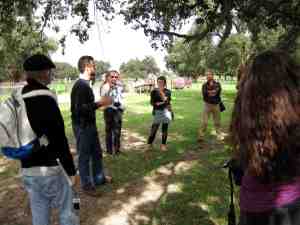 Randal Grahm, forgive me, I know you believe in the screwtop closure, but after visiting the cork oak forests in Ribatejo, Portugal today as part of the European Wine Bloggers Conference, I am now a firm believer in cork. And, if you’re listening, and I hope you will be, I will tell you why. I may not convince you in this post but hopefully by the next one.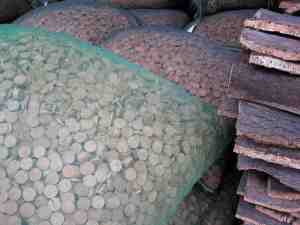


 When I applied for the “dream job” as Caretaker of the Great Barrier Reef I discovered a whole community of fellow applicants–warm, interesting people who share my interests. Same thing around this time as
 wine predator.............. gwendolyn alley