
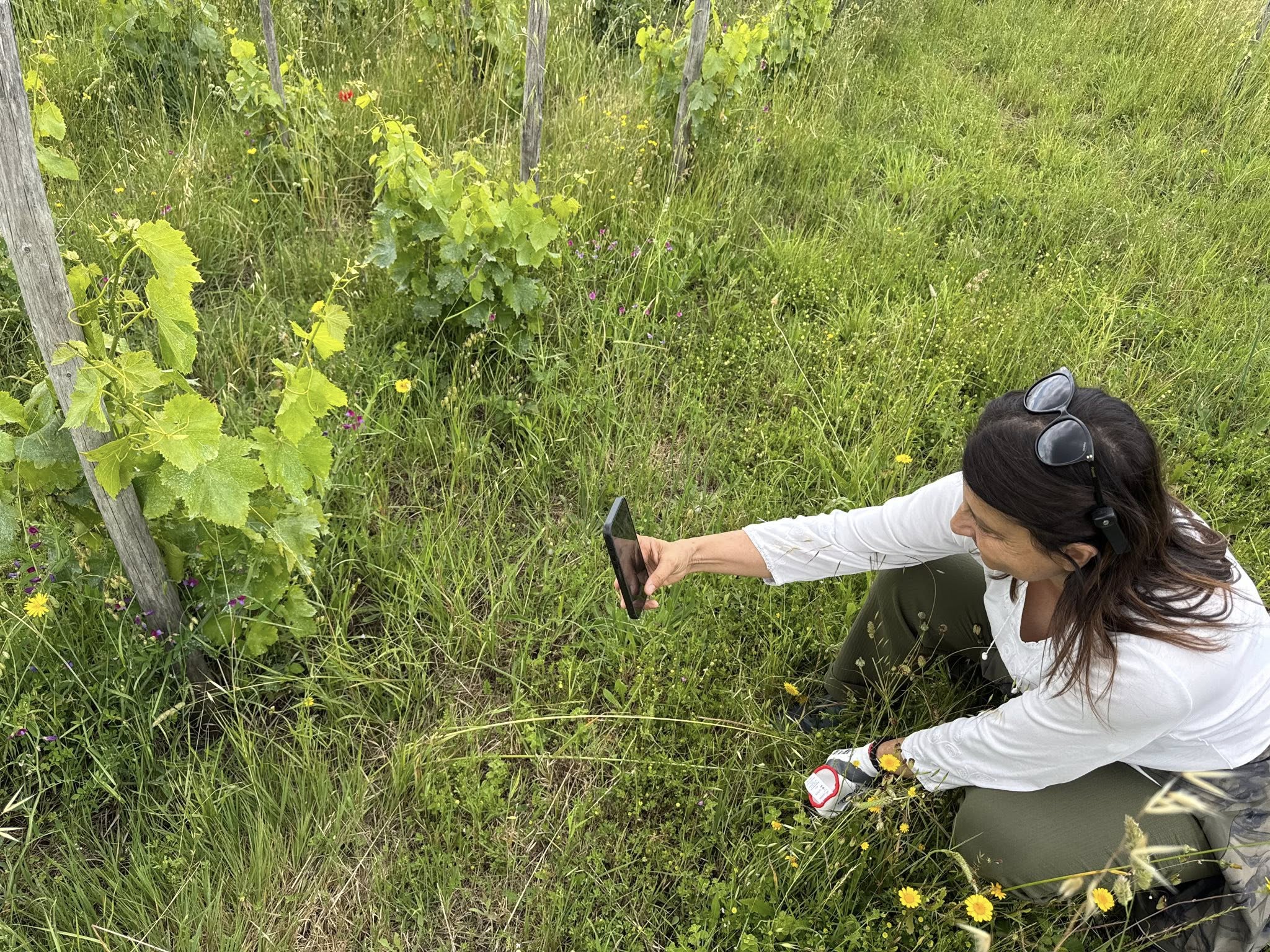
Antonella Manulli owner and winemaker at La Maliosa enjoying beautiful biodiversity in her vineyards May 2025
“Isn’t it beautiful — Procanico?” asked Antonella Manuli, the owner of Fattoria La Maliosa, in the Maremma, Southern Tuscany. We’d been together out in her Vigna Madre vineyard on a sparkling day in May where her 60 year old Procanico grows. She wanted me to see the grapes at harvest so that evening we watched this video of Procanico (scroll down to view) to know what makes this indigenous and rare Italian grape — a biotype of Trebbiano with longer pink bunches—so special to her.
“What struck me was – it was so beautiful– it is such a beautiful grape the way it becomes pink and the bunch is so elegant. It’s got a strength–it’s not a fragile beauty. It’s totally in tune with the environment. It’s resistant and resilient. Nothing is really going to screw with Procanico. Except hail– no defense from hail,” Antonella said in reference to her 70% loss of her harvest in 2023. “But everything else is okay.”
May 2025 was my third springtime visit as her guest, and I finally feel like I’m starting to understand not only the magic of Maremma, but also her regenerative agricultural practices in action— and the secrets of Procanico, which she helped resurrect.
To visit several of her vineyards including Procanico to view the progress of the vines, we traveled in her SUV on ancient narrow country roads that Etruscans built over 3000 years ago by cutting through compacted volcanic ash.
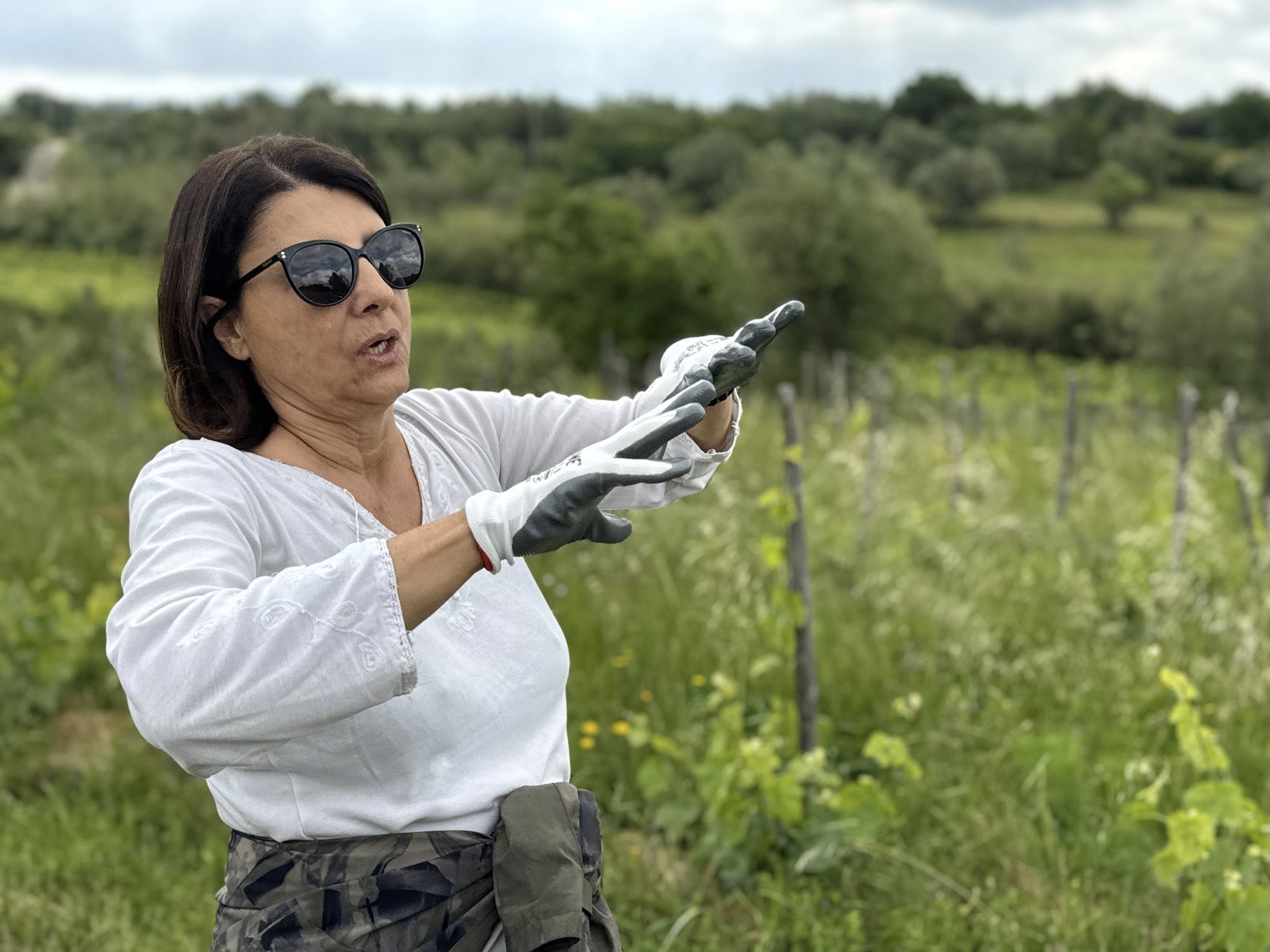
Antonella Manulli, owner and winemaker La Maliosa May 2025
Along the way we noted the biodiversity along the roadside as well as in her vineyards. In 2025, the region saw extended and gentle rainfall giving the countryside a lush green coat, with the the grassy hillsides cloaked in green with wildflowers popping up everywhere providing excellent conditions for the vines with Antonella’s regenerative agricultural techniques sopping up every last drop of 2025’s rain.
“When I came here, there was this old vineyard. I didn’t really know what varieties were there,” Antonella told me, so she hired an ampelographer, and they found Procanico, Ciliegiolo, and Grey Cannonau. “This vineyard hadn’t been tended to for at least ten years. We weren’t sure if we could get it back into production because it was in really bad shape. But it was possible because it didn’t suffer from diseases. We did a lot of work on the soil– five years to get it back to a living soil supporting the vineyard.”
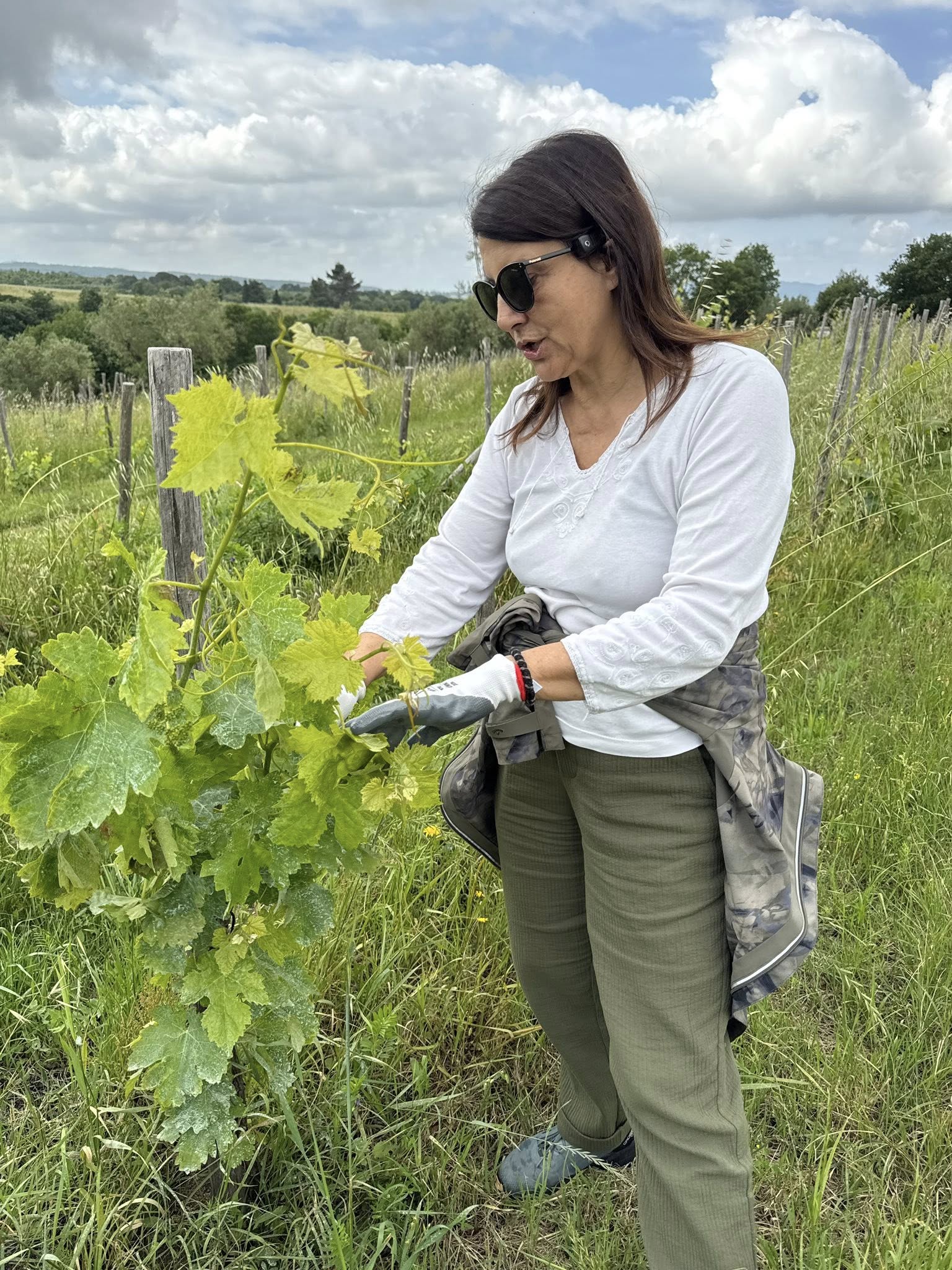
Antonella Manulli May 2025
“This is my best asset at La Maliosa, this vineyard. Vigna Madre was like a bank of DNA for us to define our viticultural project,” Antonella said.
Antonella grows hay on her property to add to the natural grasses and herbs in the vineyards which she cuts and leaves on the ground to build up the soil and maintain moisture.
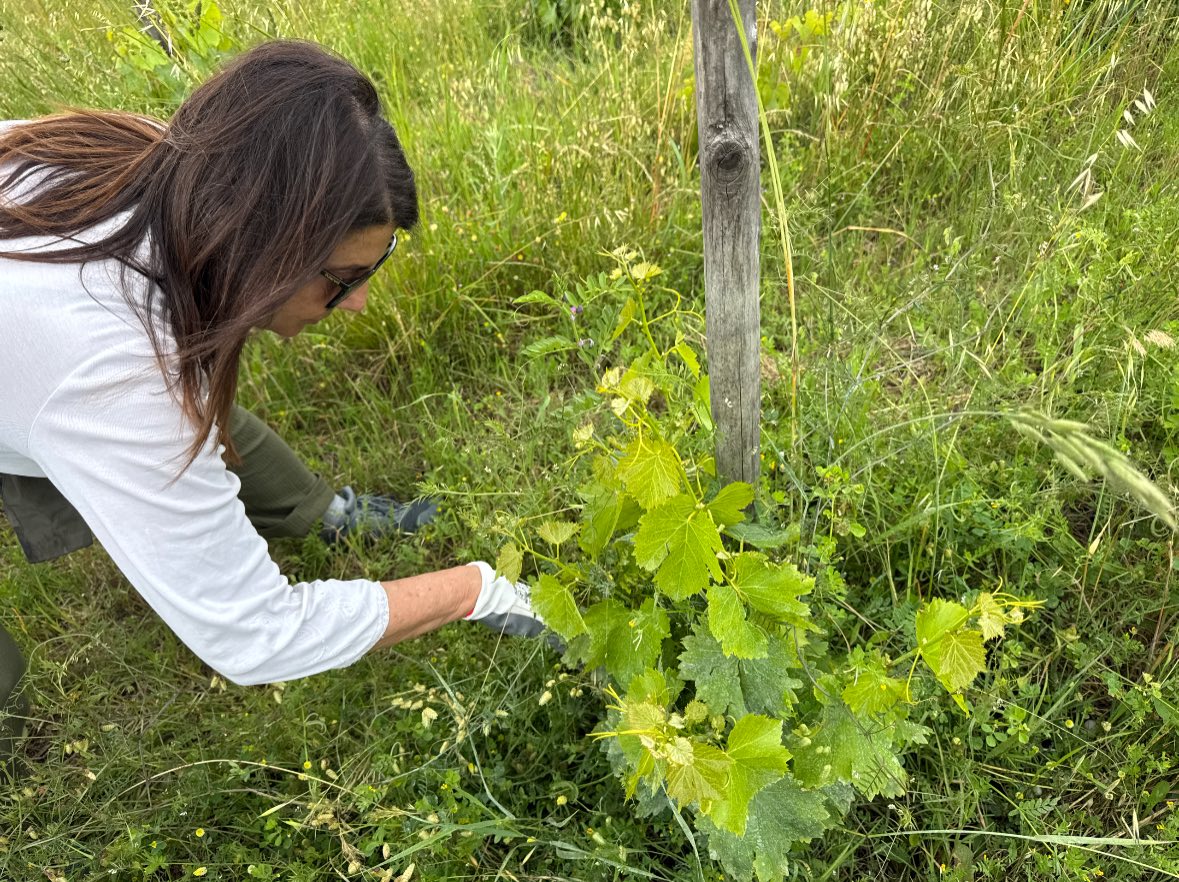
Antonella Manuli May 2025
The Maremma is a dry region, so when rain falls in the La Maliosa vineyards, it hits plants first, breaking up the drops before they reach the earth. This strategy naturally conserves each precious drop of rain in the deep mulch and the spongey volcanic soil; the rain doesn’t pound away at the soil and wash it away.
Procanico, a local clone of what’s known as Trebbiano Toscano, belongs to the large Trebbiano family, one of the most popular and oldest known vines that’s mentioned by Pliny the Elder in Naturalis Historia. La Maliosa’s Procanico vineyards come from Vigna Madre, a half hectare vineyard over 60 years old that was abandoned and renewed by Antonella, a woman dedicated to the recovery of the historical authenticity of the area including the traditional grapes.
Formerly cultivated widely in the Maremma and the Tuscan archipelago, Procanico was almost completely abandoned because it didn’t adapt to increased mechanization as well as the trend in Tuscany towards making wine from international varieties like Chardonnay. But Procanico’s vigor and hardiness allows it to withstand challenging weather conditions including high summer temperatures, droughts, and storms common during harvest. Procanico makes an excellent candidate as we propel forward toward a changing climate with unexpected and dramatic shifts.
Antonella’s goal is to make natural wines that are witness to this terroir. “In order to obtain a real natural wine,” says Antonella, it’s important the grapes are completely managed by the winery, and for the winemaker to be “there witnessing all the phases.”
Procanico is so well adapted to the Maremma, she says, that it has an extended capacity to stay on the vine — it’s very sturdy, she said– and that capacity means the grapes obtain “all the micronutrients to get a unique wine linked to the terroir. In this type of cultivation, the grape has the ability to hang longer on the vine.” She also lets the Procanico be Procanico — it’s vigorous and wants to grow in three dimensions so instead of trapping it in a trellis, she lets it grow up tall like a large tree and reach out in all directions.
While Vigna Madre is on clay soils, Antonella manages a vineyard of 35 year old Procanico vines, and she planted new vineyards using massal selection near Pitigliano. These Pitigliano vineyards are on deep volcanic ash soils which Antonella says gives Procanico its truest expression, one that’s softer and more elegant, yet still has the essence of the volcanic ash, plus elderflowers, citrus blossoms, apricot, fennel, and mint in a fascinating and compelling ever changing set of aromas and flavors on the palate. Antonella’s “orange” Uni wine is 100% Procanico and has intense aromas of apricot and spice, with apricot also on the palate, and a lovely mouthfeel with a spirited note of fresh mint mid-palate.
“Our winery made this choice to invest a lot in Procanico — a main variety for us,” concludes Antonella. “This in the end is always a winner.”
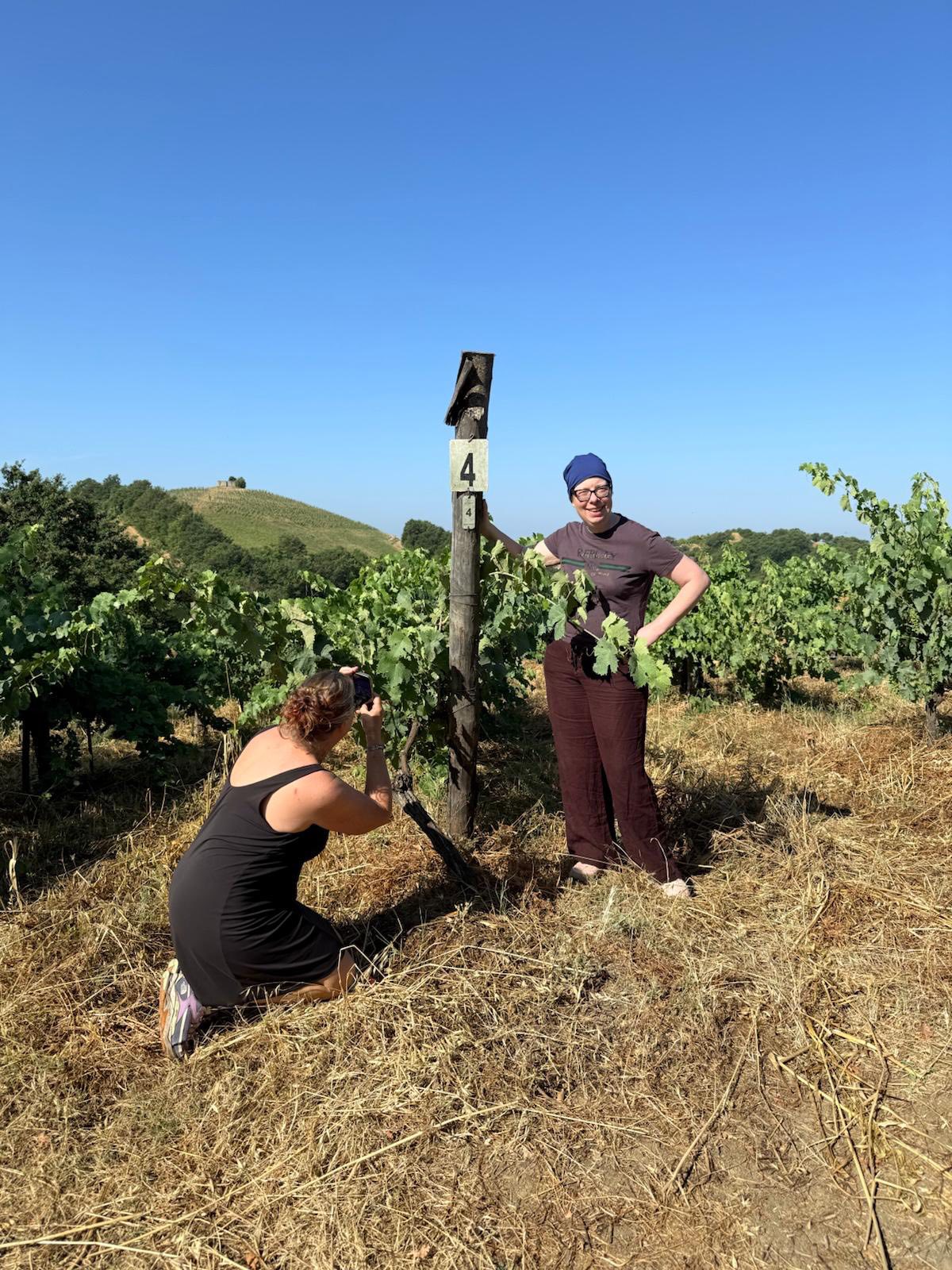
Gwendolyn Alley and Katarina Andersson pose with Procanico June 2025
Procanico grapes produce a wine that offers a complex structure with tannins surprising for a white wine and a complexity of fruits and herbs that work well with food. Give it a swirl — and you may fall in love too!
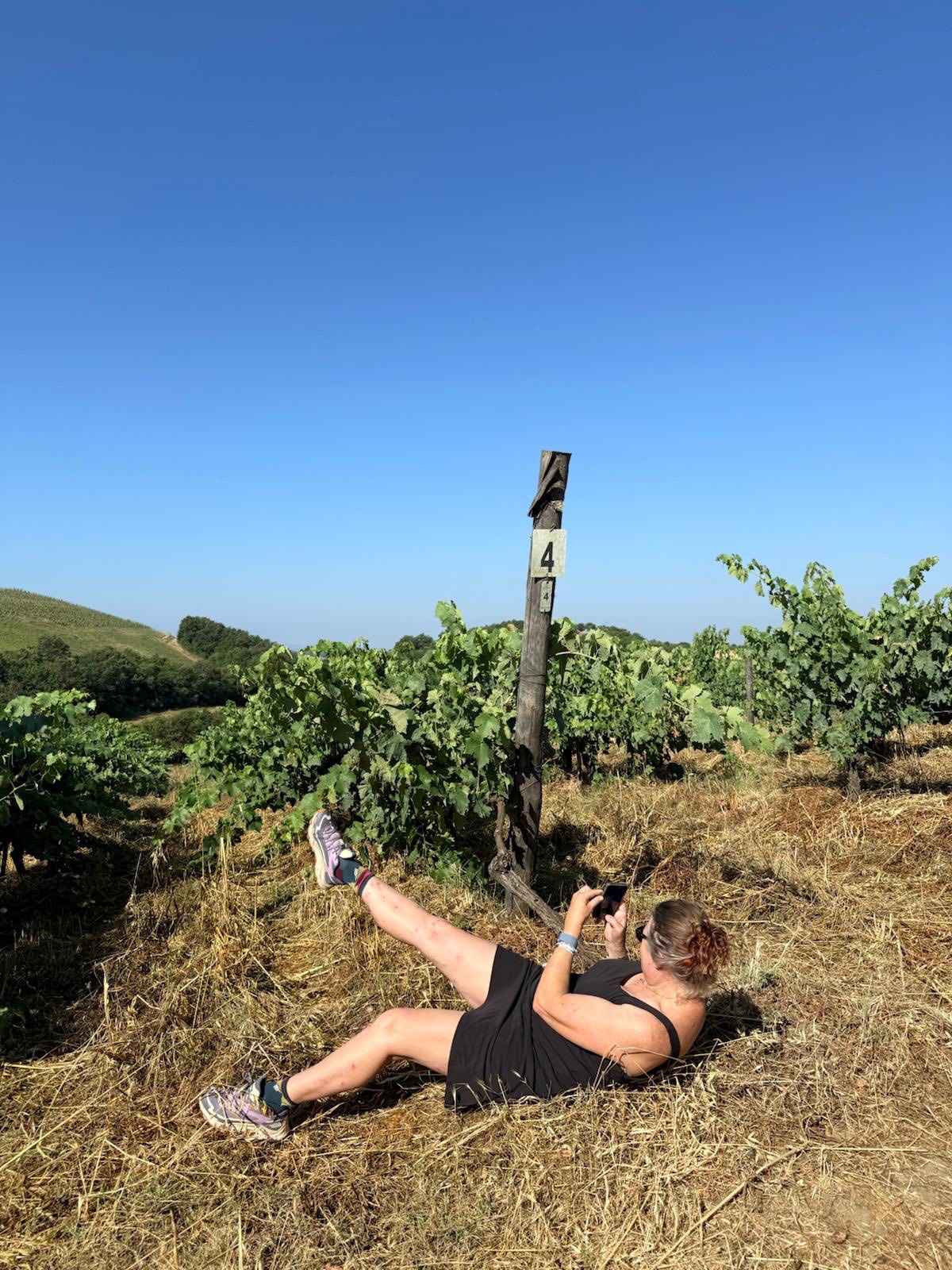
Gwendolyn Alley Wine Predator with Procanico late June 2025
Originally part of the Roman festival of Lupercalia, in 496, Pope Gelasius I made February 14 a feast day dedicated to St. Valentine. What better time to lavish love on Procanico?
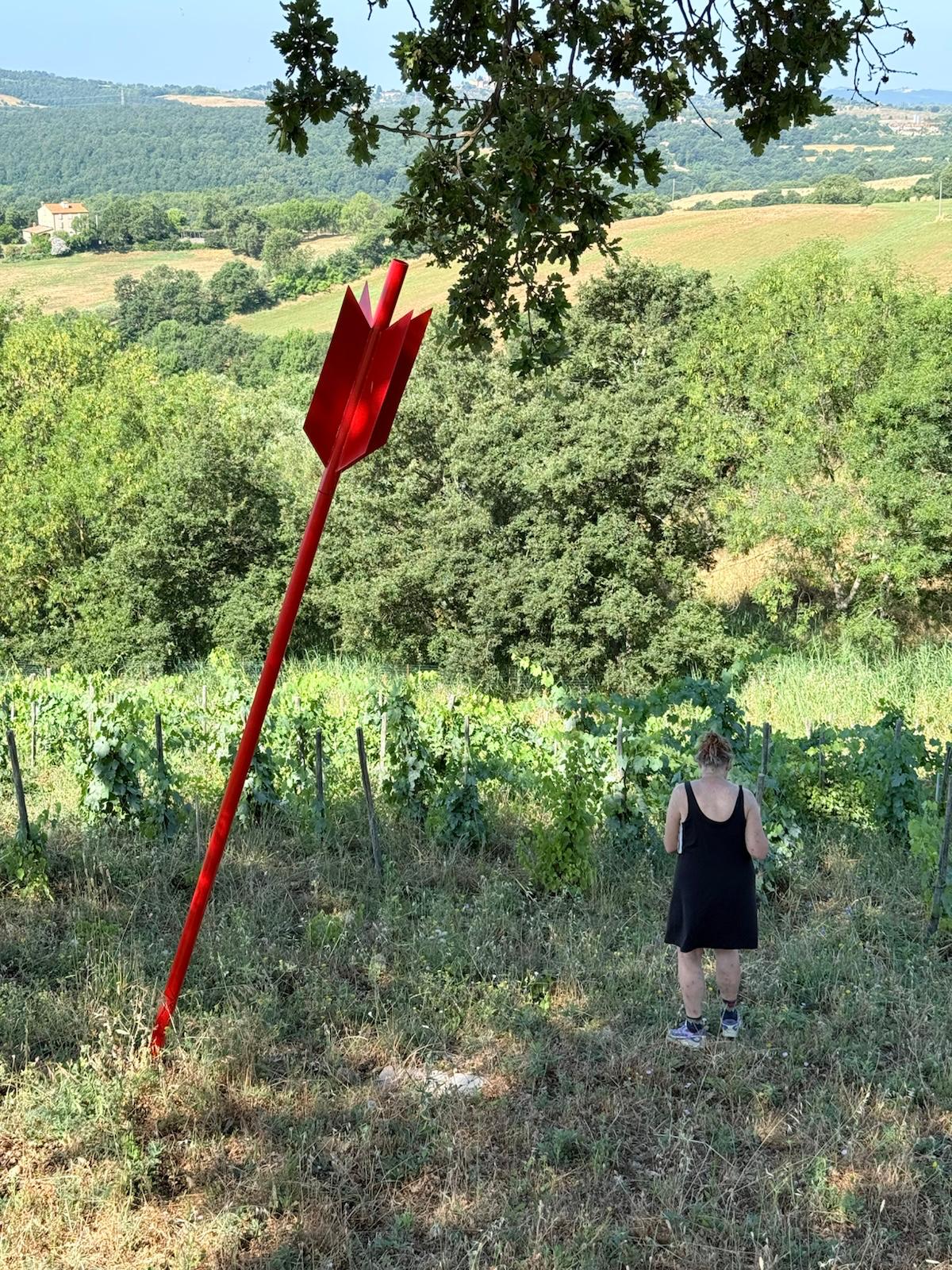
Arrow at La Maliosa strikes Wine Predator (didn’t take much for me to fall in love with Procanico! photo by Antonella Manulli) June 2025
Procanico grapes produce a wine that offers a complex structure with tannins surprising for a white wine and a complexity of fruits and herbs that work well with food. Give it a swirl — and you may fall in love too!
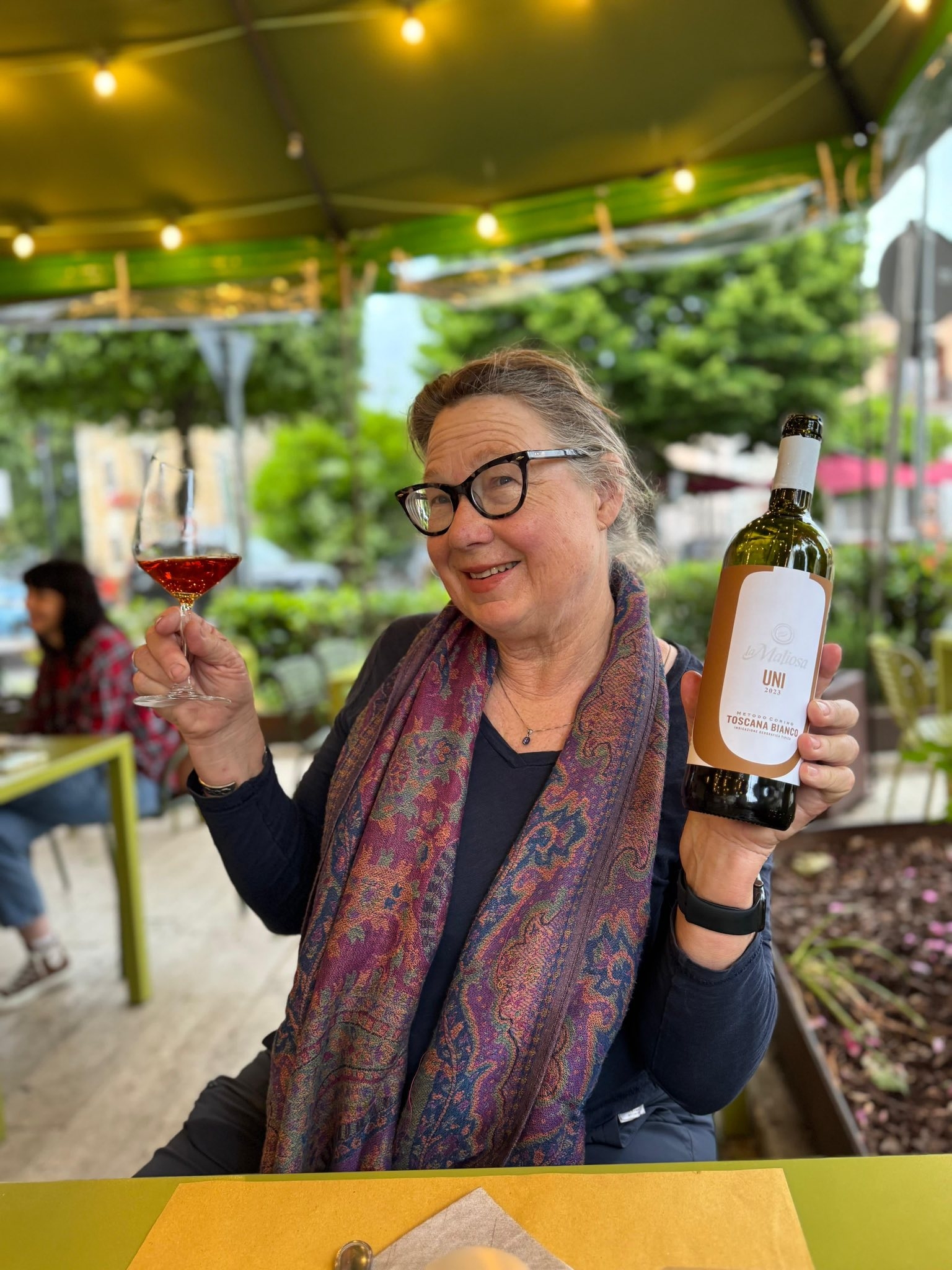
Wine Predator enjoying Uni at Saturnalia Wine Bar and Restaurant May 2025
Wines
-
2024 La Maliosa Uni Bianco Toscana Orange Wine
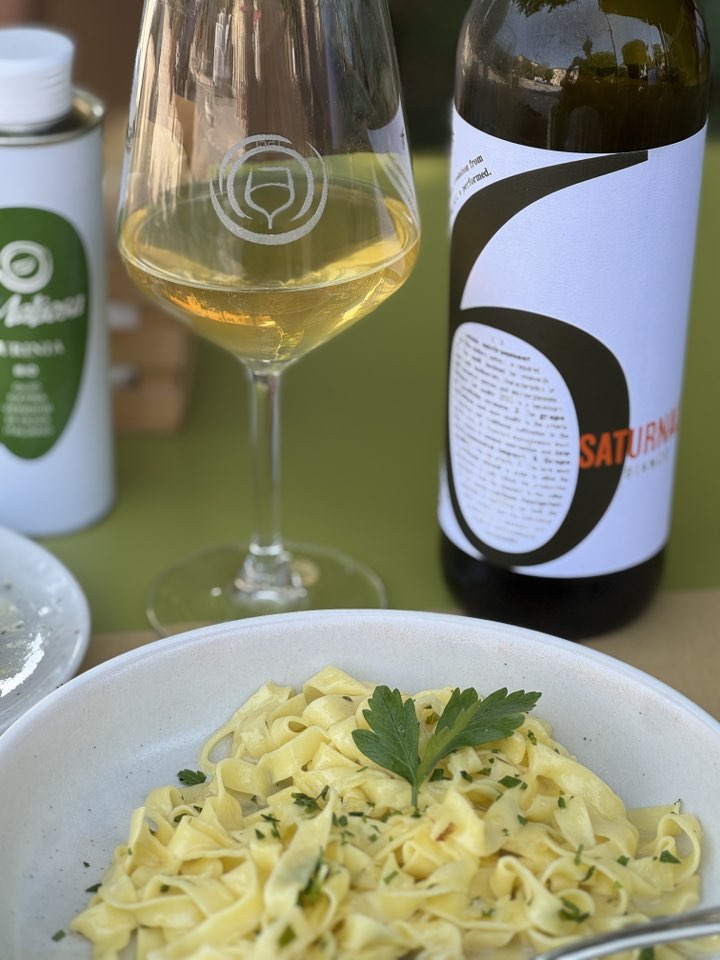
Saturnalia Wine Bar and Restaurant: preserved lemon pasta with Saturnalia wine made with procanico
Menu
Inspired by Saturnalia Wine Bar and Restaurant
Saturnalia is Antonella Manulli’s restaurant and wine bar in Saturnia, Tuscany, and where I fell in love with these two dishes, two of my favorites from six weeks in Italy in 2025. We adapted them to California cuisine.
- Tuscan style bread, La Maliosa olive oil, salt
- Pear, Pecorino, Walnut, and Arugula Salad
- Preserved Lemon Pasta
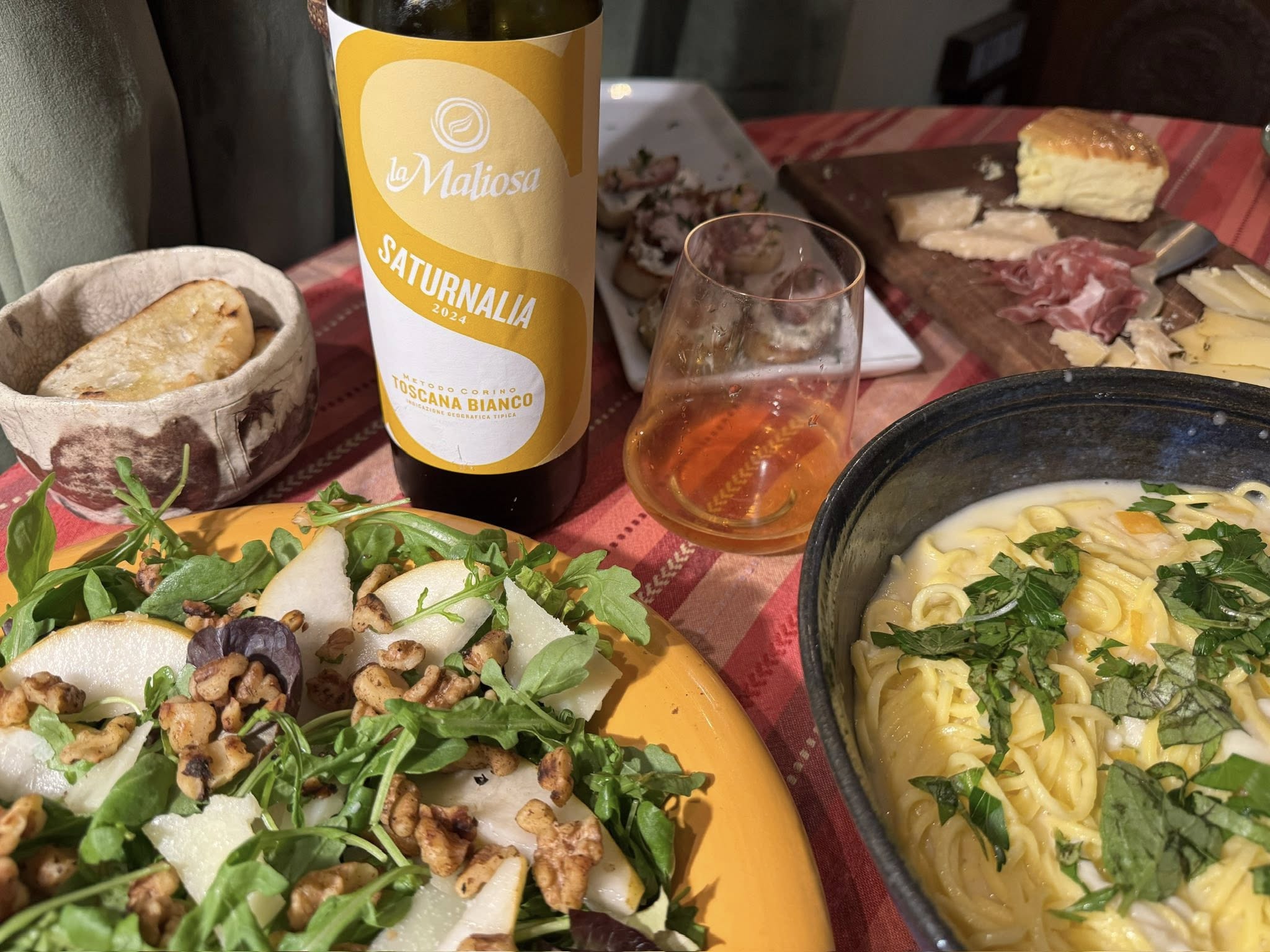
Fattoria La Maliosa Toscano Bianco “Saturnalia”
Fattoria La Maliosa Toscano Bianco “Saturnalia”
ABV: 12%
SRP: $35
Grapes: Trebbiano and Procanico
sample for my review provided by importer VeroVino
Appearance: Golden, golden amber, tiger eye, cloudy, honey rim
Aroma: Orange oil, pickle brine, herbal, ripe peach, lemon rind, honeysuckle
Palate: Big bold grippy tannins, stone fruit, green bean, very structured, yearns for food, tangerine, intense and powerful
Pairing: The wine is absolutely beautiful with the salad. Fattoria La Maliosa Toscano Bianco “Saturnalia” loves the sweet ripe pear, spicy arugula, toasted walnuts and salty pecorino. It does so well with the citrusy salty cheesy pasta as the bright flavors in the pasta bring out lovely fruit in the wine.
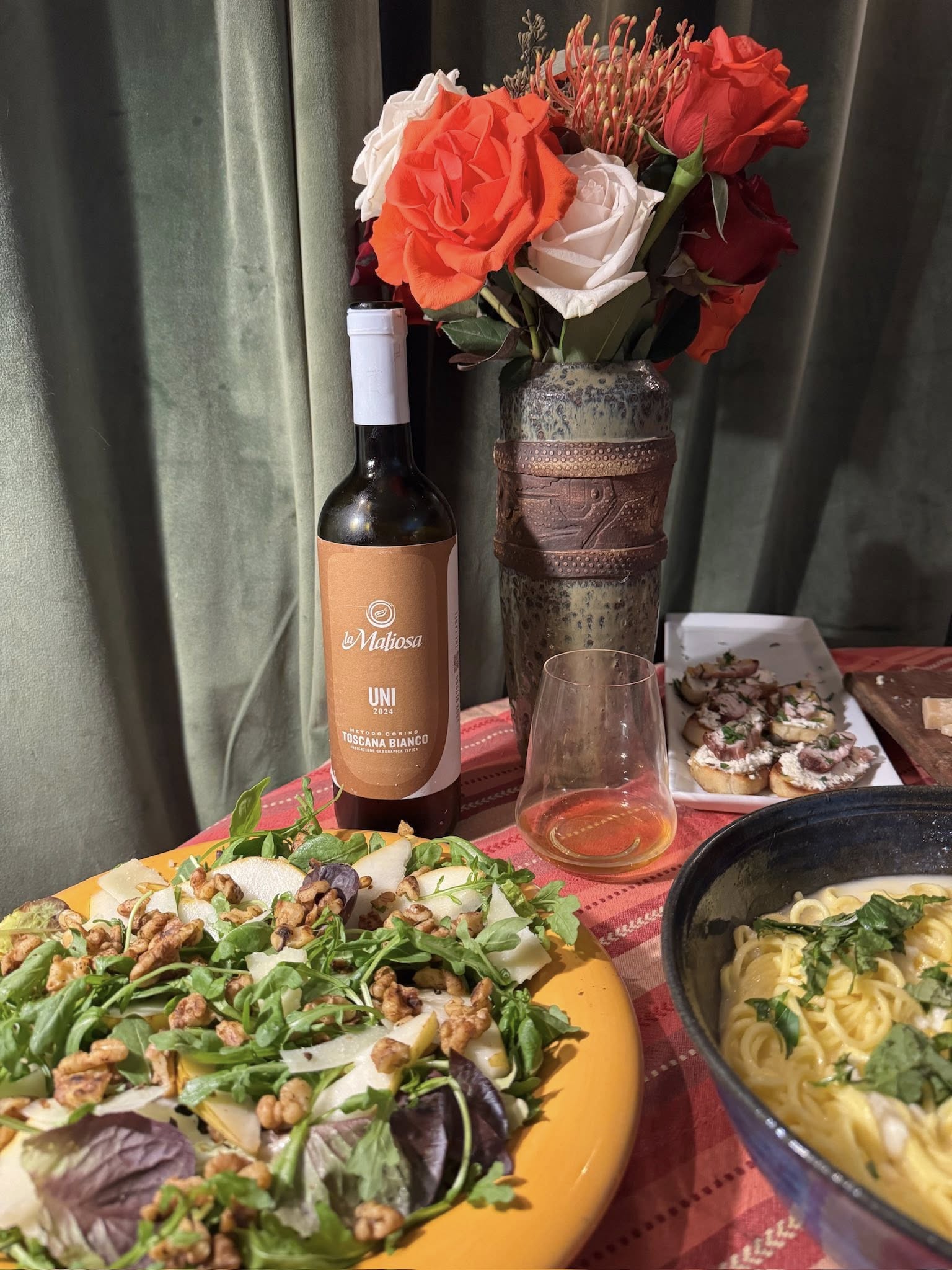
Fattoria La Maliosa Toscano Bianco “Uni”
Fattoria La Maliosa Toscano Bianco “Uni”
ABV: 12%
SRP: $55
Grapes: Procanico
sample for my review provided by importer VeroVino
Appearance: Amber, slightly cloudy, gold rim
Aroma: Rose geranium, apricot nectar, ash, volcanic soil
Palate: Slick texture, iron, stone fruit, structure, balanced tannins and bright acidity, mineral rich soil, nectarine, orange oil.
Pairing: Very nice with the salad the wine as it becomes very smooth and the fruit is enhanced. The wine loves the pasta as together they bring out minerality, salinity, and bright tart fruit; together they are completely happy. The pasta brings out lovely sweet fruit in the wine, apricot, nectarine; it is all there with the salty citrusy pasta dish.
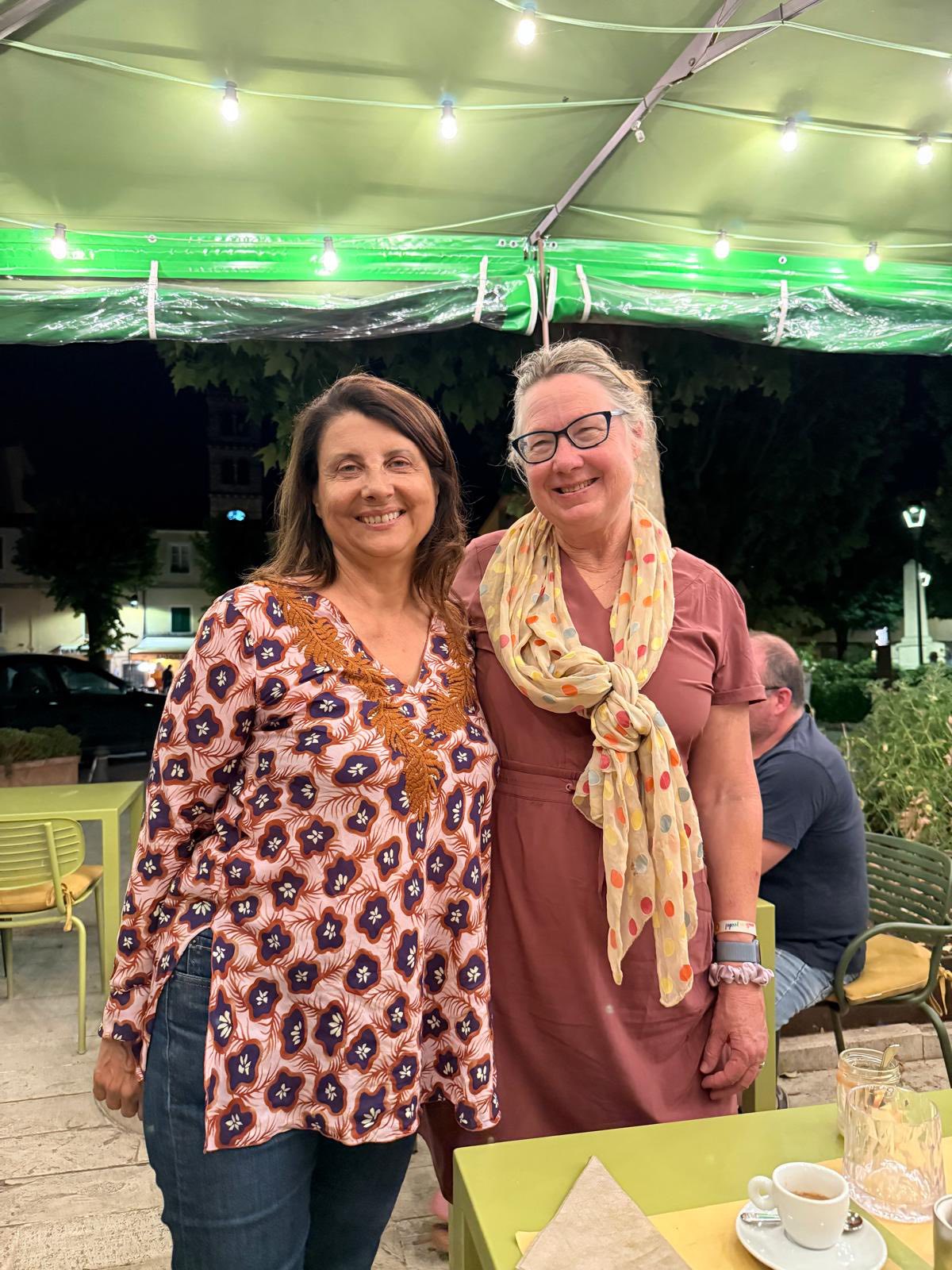
Antonella Manulli and Gwendolyn Alley at Saturnalia July 2025
 wine predator.............. gwendolyn alley